BMC Elections
- Past BMC Election Results
- Know your Booth Location
- Standing Committee Members
- BMC Elections 2017 Delimitation
- New Ward List Civic Elections 2025
- New Wards Maps for BMC Elections 2025
- BMC Election 2025 Date
- CEO Maharashtra
- Know Your BMC
- BMC News & Updates
- Wards
- Candidates
- Mumbai Corporators
- Advertise
- Contact
- Volunteer
- Privacy Policy
Thackeray Brothers’ Ganesh Chaturthi Meeting Fuels Speculation on Civic Poll Strategy
- by Webdesk
- 27 Aug 2025
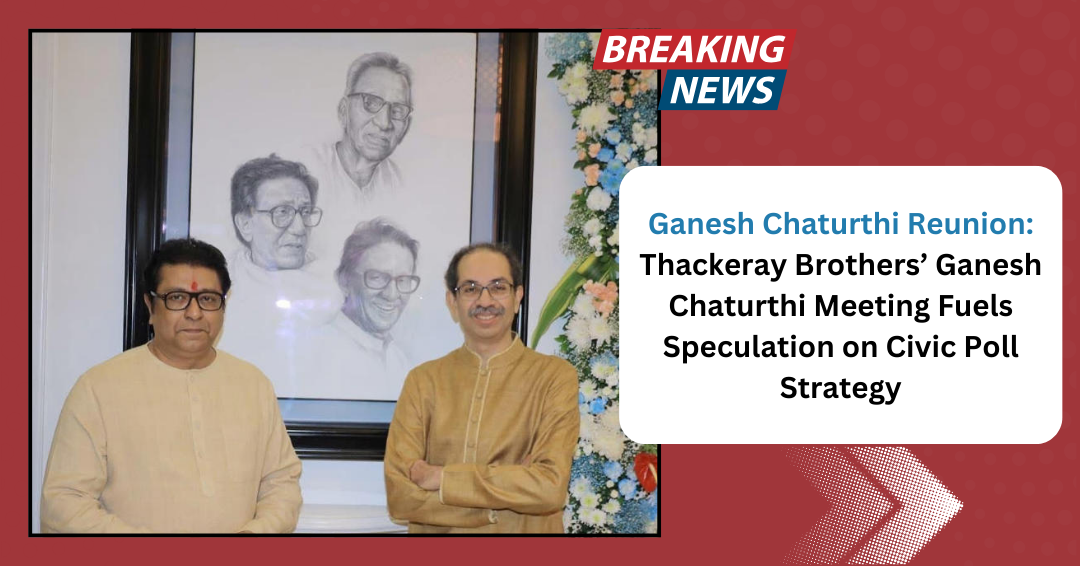
Source: The Times Of India
Mumbai: Ganesh Chaturthi on Wednesday turned into a politically significant moment when former Maharashtra Chief Minister and Shiv Sena (UBT) chief Uddhav Thackeray paid a visit to his cousin and Maharashtra Navnirman Sena (MNS) president Raj Thackeray at his Mumbai residence. While the visit was officially to offer prayers to Lord Ganesha, it also once again underlined the increasing warmth and cordiality between the two cousins, whose personal and political relationship has often been marked by years of friction and rivalry.
The meeting has further fuelled speculation in the state’s political circles that the renewed friendship between Uddhav and Raj could potentially translate into a formal alliance in the upcoming civic elections, especially the high-stakes BMC polls. Political observers point out that even though both cousins have in the past chosen different political paths after their split from the Shiv Sena’s original fold, their recent interactions suggest a conscious attempt to rebuild personal ties, which may well have larger political implications.
This Ganesh Chaturthi meeting was not the first such interaction between the two leaders in recent times. In fact, it marked at least the third public exchange of goodwill between Uddhav and Raj within just a few months. Earlier in July, Raj Thackeray had made a visit to Matoshree, the iconic family residence of the Thackerays in Bandra East, to personally greet Uddhav Thackeray on his birthday. The visit carried significant symbolism, as Matoshree has historically been regarded as the nerve centre of Shiv Sena politics during the era of the late Balasaheb Thackeray, who was both Uddhav and Raj’s political mentor.
During that July meeting, Raj presented Uddhav with a bouquet of red roses, and in return, Uddhav welcomed him with a warm embrace. The gesture, captured widely in photographs and circulated across media platforms, was interpreted as an unmistakable signal of thawing relations between the two estranged cousins. Many within the political fraternity saw it as the beginning of a process of reconciliation, hinting at a possible MNS–Shiv Sena (UBT) collaboration in the near future.
The signs of their growing closeness were further reinforced when the two Thackerays shared a stage in July during a joint celebration over what they termed as their “victory” against the state government’s controversial policies. The Maharashtra government had earlier introduced government resolutions (GRs) mandating a three-language formula for Classes 1 to 5, which included a strong emphasis on Hindi. Both Uddhav and Raj Thackeray vocally opposed the move, arguing that it amounted to an “imposition of Hindi” on Maharashtrian students at the cost of Marathi and regional autonomy. Their combined pressure, supported by sections of civil society, eventually forced the state government to withdraw the GRs.
The united stand of Uddhav and Raj against the language policy was hailed as a rare moment of solidarity between the two leaders. For supporters of both parties, it revived memories of the days when the Thackeray family commanded a united Shiv Sena under Balasaheb’s leadership. For critics, however, it raised fresh questions about whether this closeness was merely circumstantial or if it was the beginning of a carefully crafted political strategy ahead of key local body elections.
With the Brihanmumbai Municipal Corporation (BMC) elections looming large, the political significance of these gestures cannot be ignored. The BMC, considered the richest municipal body in Asia, has always been the Shiv Sena’s bastion. However, after the split within the Sena, the party’s control over the civic body is under serious threat. An alliance between Uddhav’s Sena (UBT) and Raj’s MNS could alter the balance of power, making the contest far tougher for their opponents, particularly the BJP and Eknath Shinde’s Shiv Sena faction.
For now, neither Uddhav Thackeray nor Raj Thackeray has made any public announcement about a political tie-up. Yet, their repeated meetings, the exchange of symbolic gestures, and their coming together on contentious policy issues strongly suggest that a larger plan may be in motion. Political experts believe that beyond personal reconciliation, both leaders stand to gain strategically from a partnership—Uddhav by consolidating Marathi votes that might otherwise drift, and Raj by regaining political relevance after years on the sidelines.
As Ganesh Chaturthi festivities continue, one thing is clear: the Uddhav–Raj dynamic is fast becoming a talking point in Maharashtra’s political corridors. Whether this renewed warmth will translate into an electoral pact remains to be seen, but it has certainly added a new dimension to the upcoming civic poll narrative.
Image Courtesy:
Related News
This article is based on publicly available information from credible sources (as mentioned above) and has been restructured using a combination of AI tools and manual editorial inputs to enhance clarity and readability. While we aim to maintain accuracy, there may be unintentional errors or misinterpretations. If you come across any incorrect or misleading information, please report it to us at info@bmcelections.com.
Copyright © 2026 All Rights Reserved | BMC Election