BMC Elections
- Past BMC Election Results
- Know your Booth Location
- Standing Committee Members
- BMC Elections 2017 Delimitation
- New Ward List Civic Elections 2025
- New Wards Maps for BMC Elections 2025
- BMC Election 2025 Date
- CEO Maharashtra
- Know Your BMC
- BMC News & Updates
- Wards
- Candidates
- Mumbai Corporators
- Advertise
- Contact
- Volunteer
- Privacy Policy
Supreme Court blasts! Orders Maharashtra Election Commission, BMC elections in January?
- by Webdesk
- 16 Sep 2025
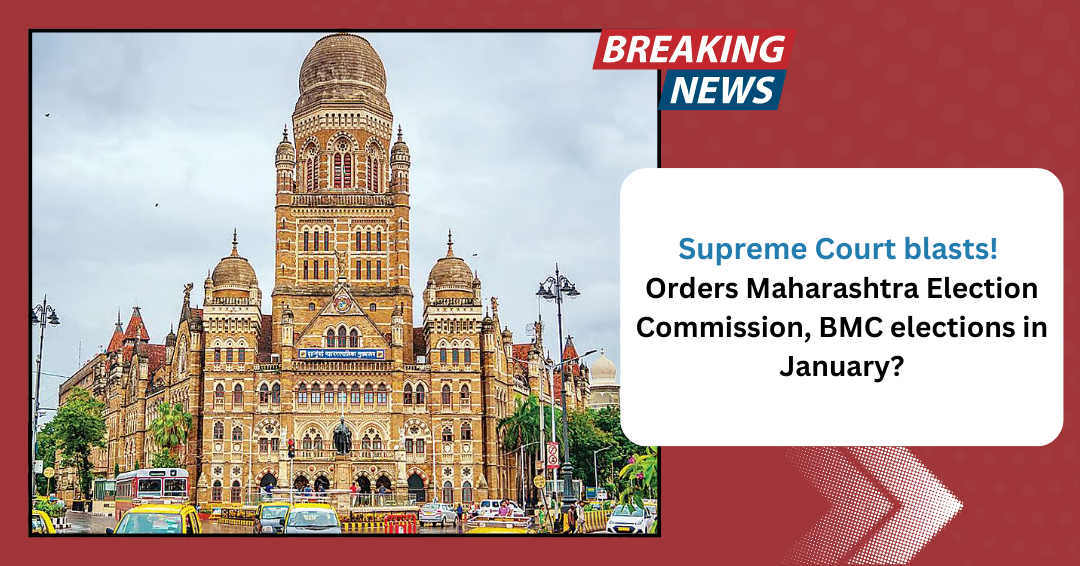
Source: NDTV Profit
Supreme Court’s Stern Stand: Maharashtra Local Body Elections Must Be Held by January 2026
On Tuesday, the Supreme Court of India strongly criticized the Maharashtra State Election Commission (SEC) for failing to follow the earlier schedule mandated by the court regarding local body elections in the state. Expressing dissatisfaction, the apex court extended the deadline only as a “one-time concession”, and categorically directed that all local body elections in Maharashtra must be completed no later than January 31, 2026. The bench made it equally clear that no further extension will be granted under any circumstances.
This directive carries major significance since polls for several key civic bodies are long overdue, including the prestigious Brihanmumbai Municipal Corporation (BMC), the governing body of Mumbai. The court’s order effectively puts pressure on the Maharashtra State Election Commission and the state government to move forward without delay.
Elections Pending Since 2017
It is important to recall that the last round of civic elections in Maharashtra was held way back in 2017, covering municipal corporations, municipal councils, and nagar panchayats. Since then, the tenure of several elected bodies has expired, but fresh elections have not taken place. This long gap has raised serious concerns about democratic representation at the local level.
The Supreme Court observed that the SEC had failed to comply with previous directions, which had clearly stated that the pending local body elections must be conducted on time. The apex court, therefore, intervened once again to ensure that democratic processes are not indefinitely stalled.
Clear Deadline – January 2026
The two-judge bench, comprising Justice Surya Kant and Justice Joymalya Bagchi, issued a sharp reminder:
“All local bodies, including Zila Parishads, Panchayat Samitis, municipal corporations, and all other municipalities in Maharashtra, must go to polls and complete the election process by January 31, 2026. This is the final extension. No further delay will be entertained.”
This order now binds the Maharashtra State Election Commission to set the electoral machinery in motion.
Background of the Case
According to Advocate Devdatt Palodkar, the chain of events leading to this decision began on May 6, 2025, when the Supreme Court had first directed both the Maharashtra Government and the SEC to notify local body elections within two weeks and to complete the process within four weeks. A clear deadline of September 6, 2025 had been fixed by the court.
However, the SEC failed to act within the stipulated time. Neither were the elections declared, nor was the process initiated. As a result, the SEC filed an application before the court seeking an extension of time. The matter, though not formally listed for hearing, was taken up through oral submissions. After considering the request, the Supreme Court granted an extension but also underlined that this would be the last such concession.
Impact on Maharashtra’s Political Landscape
The court’s directive is likely to reshape the state’s political narrative, especially in urban centers like Mumbai, Pune, and Nagpur. With BMC elections overdue, political parties are already in high gear, treating the polls as a semi-final ahead of bigger state and national contests. The BJP, Shiv Sena factions, Congress, and NCP groups will all be forced to accelerate preparations, as no more excuses will be accepted once the January 2026 deadline is in place.
Moreover, the move will revive democratic functioning at the grassroots level. Local bodies play a crucial role in governance, urban planning, and public services. The absence of elected representatives for such an extended period has left administrative gaps that now need urgent correction.
Conclusion
By setting a hard deadline of January 31, 2026, the Supreme Court has sent out a strong message: democratic accountability cannot be compromised. The Maharashtra State Election Commission and the state government are now left with no choice but to conduct and complete all pending local body elections within the stipulated timeframe.
This order is not just about elections—it is about upholding the democratic framework in one of India’s most politically significant states. With the timeline clearly defined and no further extensions allowed, Maharashtra now stands at the threshold of a crucial electoral exercise that could alter its political equations in the years to come.
Image Courtesy:
Related News
This article is based on publicly available information from credible sources (as mentioned above) and has been restructured using a combination of AI tools and manual editorial inputs to enhance clarity and readability. While we aim to maintain accuracy, there may be unintentional errors or misinterpretations. If you come across any incorrect or misleading information, please report it to us at info@bmcelections.com.
Copyright © 2026 All Rights Reserved | BMC Election