BMC Elections
- Past BMC Election Results
- Know your Booth Location
- Standing Committee Members
- BMC Elections 2017 Delimitation
- New Ward List Civic Elections 2025
- New Wards Maps for BMC Elections 2025
- BMC Election 2025 Date
- CEO Maharashtra
- Know Your BMC
- BMC News & Updates
- Wards
- Candidates
- Mumbai Corporators
- Advertise
- Contact
- Volunteer
- Privacy Policy
Raj-Uddhav alliance talks are gaining momentum, but there will be no impact on BMC elections
- by Webdesk
- 19 Sep 2025
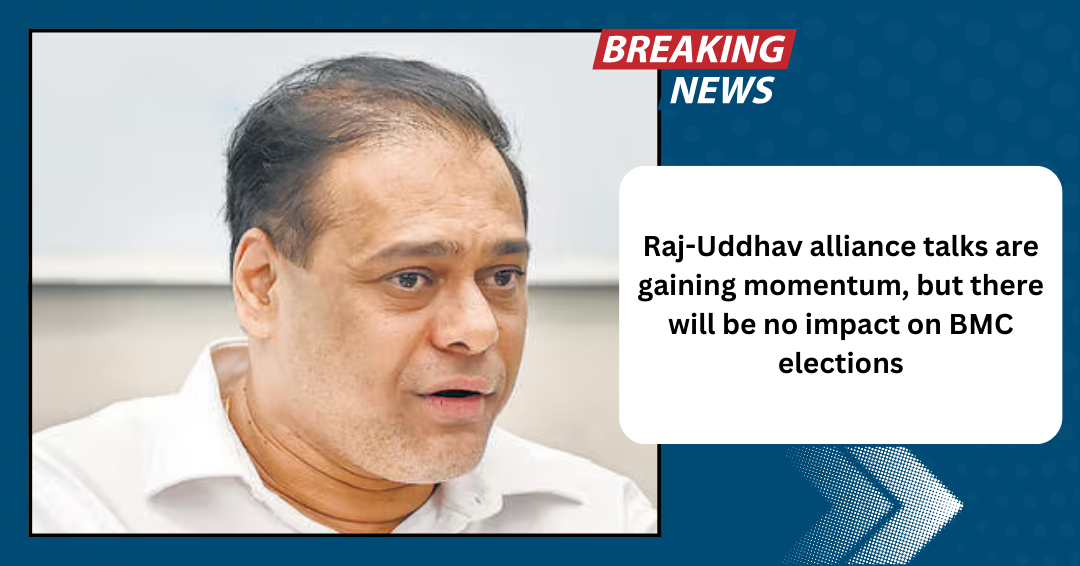
Source: Hindustan Times
Mumbai: Newly-appointed Mumbai BJP president Ameet Satam has spelt out his party’s priorities ahead of the Brihanmumbai Municipal Corporation (BMC) elections. Taking charge of the city unit just last month, Satam emphasized that the BJP’s agenda is to transform Mumbai into a “world-class city” with reliable roads, modernized infrastructure, efficient public transport, and above all, strong security for its citizens.
Speaking in an interaction at the HT newsroom, Satam said the city faces challenges from “anti-national elements,” which his party intends to counter decisively. He added that political equations such as a possible alliance between Uddhav Thackeray and Raj Thackeray’s MNS are of little concern to the BJP.
Ensuring Safety and Identity
Satam explained that the BJP’s election pitch would focus on two pillars: safeguarding the city’s identity and ensuring the safety of Mumbaikars. Drawing parallels with international cities where extremist elements have gained ground, he cautioned that Mumbai too faces a similar risk. “The bigger challenge before us is to ensure that such forces never take root here,” he remarked.
Migration and Illegal Infiltration
Asked about migration, Satam clarified that his concern is not about Indians moving to Mumbai but about illegal immigrants, particularly the Bangladeshi population and separatist-minded groups. He recalled instances of Pakistani flags being waved during rallies and highlighted the involvement of individuals linked to the 1993 blasts in local campaigns. Such developments, he warned, threaten the city’s long-term stability and safety.
Role of Shiv Sena and Uddhav Thackeray
On the Shiv Sena’s influence, Satam asserted that the “real Sena” which follows Balasaheb Thackeray’s ideology remains with BJP and Chief Minister Eknath Shinde. Of the 84 corporators elected in the 2017 civic polls, he noted, 54 are with Shinde and only 30 with Uddhav Thackeray. This, he argued, proves that Uddhav has lost the city’s sentiment. Satam also dismissed the potential impact of a Raj-Uddhav tie-up, calling MNS a “very small force in Mumbai politics.”
Mahayuti Seat Sharing
Regarding seat-sharing within the Mahayuti alliance, Satam confirmed there would be an understanding with Shinde’s camp. “Numbers don’t matter as much as the bigger goal of delivering corruption-free governance, protecting Mumbai, and ensuring its development,” he said. Decisions on seat distribution will be made closer to the elections based on local ward-level dynamics.
Infrastructure and Development
Mumbai’s ongoing infrastructure push has often been criticized as benefiting only the wealthy. Satam refuted this, pointing out that the metro is widely used and has reduced congestion for everyone, not just the affluent. He highlighted how the Andheri–Dahisar metro line eased pressure on the Western Express Highway and how railway upgrades benefited millions of daily commuters across MMR.
However, he admitted that life in Mumbai has become tougher. With a population of over 1.5 crore squeezed into just 46% of the city’s area (as large portions remain forests, wetlands, and mangroves), space constraints continue to intensify.
Road Woes and Solutions
Satam identified poor roads as Mumbai’s most pressing civic issue. He criticized the ₹21,000 crore spent during Uddhav Thackeray’s BMC tenure, alleging that the quality of work was poor. Repeated digging by multiple utility agencies only made matters worse, he said, proposing instead a dedicated “utility corridor” system to avoid constant road excavation.
Marathi Manoos and BJP’s Image
Addressing the perception of BJP as a pro-Gujarati party, Satam argued that it was the Modi government that gave Marathi classical language status and allocated 500 sq ft homes to locals. He accused rivals of spreading false narratives, adding that “Marathi Manoos know who has truly stood by them.”
Reviving BEST and PPP Models
On the city’s bus service, Satam said BEST should operate on a self-sustainable model rather than relying on state or civic subsidies. He suggested leveraging land and advertising assets for revenue.
Commenting on public-private partnerships, he said PPP could help in sectors like healthcare, but opposed privatizing public spaces such as gardens, swimming pools, and grounds. “These must stay with BMC, because once such spaces are handed over, they are never vacated,” he warned.
Dream for Mumbai
Looking ahead, Satam said his dream is to reshape Mumbai into a city that matches international standards. “Unfortunately, ‘BMC’ has become a negative word. Our mission is to change that into a positive one. Every Mumbaikar should feel the ease of living here. Ideally, one should be able to travel from one corner of Mumbai to another within an hour,” he said, summing up his vision.
Image Courtesy:
Related News
This article is based on publicly available information from credible sources (as mentioned above) and has been restructured using a combination of AI tools and manual editorial inputs to enhance clarity and readability. While we aim to maintain accuracy, there may be unintentional errors or misinterpretations. If you come across any incorrect or misleading information, please report it to us at info@bmcelections.com.
Copyright © 2026 All Rights Reserved | BMC Election