BMC Elections
- Past BMC Election Results
- Know your Booth Location
- Standing Committee Members
- BMC Elections 2017 Delimitation
- New Ward List Civic Elections 2025
- New Wards Maps for BMC Elections 2025
- BMC Election 2025 Date
- CEO Maharashtra
- Know Your BMC
- BMC News & Updates
- Wards
- Candidates
- Mumbai Corporators
- Advertise
- Contact
- Volunteer
- Privacy Policy
Political decision Commission yet to choose VVPAT slips and EVM consider essential information
- by Webdesk
- 06 Feb 2021
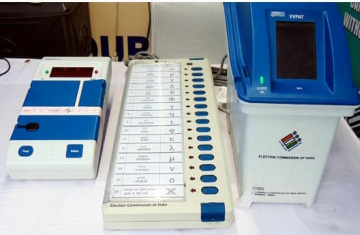
When the Election Commission and its technical committee refused to submit the answer to questions from the Citizens' Commission of Elections (CCE), the interim report provides a valuable addition to the growing literature on EVMs in India. CCE by Bappa Sinha of the Free Software Movement. In his 14-page submission, Sinha points to two things. In 2012, the Supreme Court said that the "paper trial" was an inescapable requirement for free and fair elections.
Voter confidence in EVMs can only be achieved by introducing a paper trial. This led to the introduction of VVPAT terminals in all EVMs in India. However, it still raises the question of what is a primary record, electronic data or paper trial. What happens if they do not match? This question has already been raised before the ECI. The ECI has not yet commented. Now that every EVM has VVPATs, we can consider EVM as a voter ballot printer and an electronic calculator. As a printer, it prints the ballot with the ballot, and as a calculator it is the sum of the votes. By law, the ballot must be a VVPAT slip. In case of a dispute, or challenge of a losing candidate, the VVPAT slips should be considered and the case decided on its basis. Sinha also raises a technical issue with EVMs used by EC.
“Another significant plan standard expressed by the EC is that the product utilized on these machines consumes into a' once programmable 'chip that can't change or harm the product on these machines. A 'one-time programmable' chip can only be programmed once during production and then cannot be rebuilt.
Therefore, software programmed on the chip cannot be modified without someone replacing the physical chip. It turns out that EVMs violate this design principle of the EC. In response to a RTI request, Bell stated that EVMs used the MK61FX512VMD12 microcontroller from NXP, a multi-national semiconductor manufacturer. The RTI response led the reader to the NXP website for more information, which certainly lists this microcontroller. Section 8 (1) (d) of the RTI Act. The data sheet for the MK61FX512VMD12 microcontroller on NXP's website states that it is an ARM based microprocessor with 16Kbytes EEPROM, 512KB of flash and 128 KB of SRAM. EEPROM stands for "Electronically Arasable Programmable Read-Only Memory", which, as the name implies, can be electronically erased and rebuilt.
The data sheet states that 512 KB of flash memory can be partitioned, with a portion of this memory being used to store software code and the rest to be used for data. This flash memory can also be overwritten. NXP and other vendors provide development kits so that software for these chips can be developed and converted. In EVMs, the software is stored in EEPROM or flash memory (or both), both of which can now be rebuilt and replaced. Therefore, ECI's claim that EVM software is stored on an OTP chip is clearly incorrect.
We need to follow with the ECI that they do not follow the procedures that they claim to follow themselves and that EVM is following the Indira sen Committee Report Bell of 2006, that is, "it cannot effectively change the specific nature of the software integrated with the processor".
Image Courtesy: BMC Election Updates
Related News

This article is based on publicly available information from credible sources (as mentioned above) and has been restructured using a combination of AI tools and manual editorial inputs to enhance clarity and readability. While we aim to maintain accuracy, there may be unintentional errors or misinterpretations. If you come across any incorrect or misleading information, please report it to us at info@bmcelections.com.
Copyright © 2026 All Rights Reserved | BMC Election