BMC Elections
- Past BMC Election Results
- Know your Booth Location
- Standing Committee Members
- BMC Elections 2017 Delimitation
- New Ward List Civic Elections 2025
- New Wards Maps for BMC Elections 2025
- BMC Election 2025 Date
- CEO Maharashtra
- Know Your BMC
- BMC News & Updates
- Wards
- Candidates
- Mumbai Corporators
- Advertise
- Contact
- Volunteer
- Privacy Policy
"Mumbai’s Political Battle: Hindutva Ideology, Marathi Identity Politics, and the Crucial BMC Clash Set to the City’s Power Equation"
- by Webdesk
- 22 Jul 2025
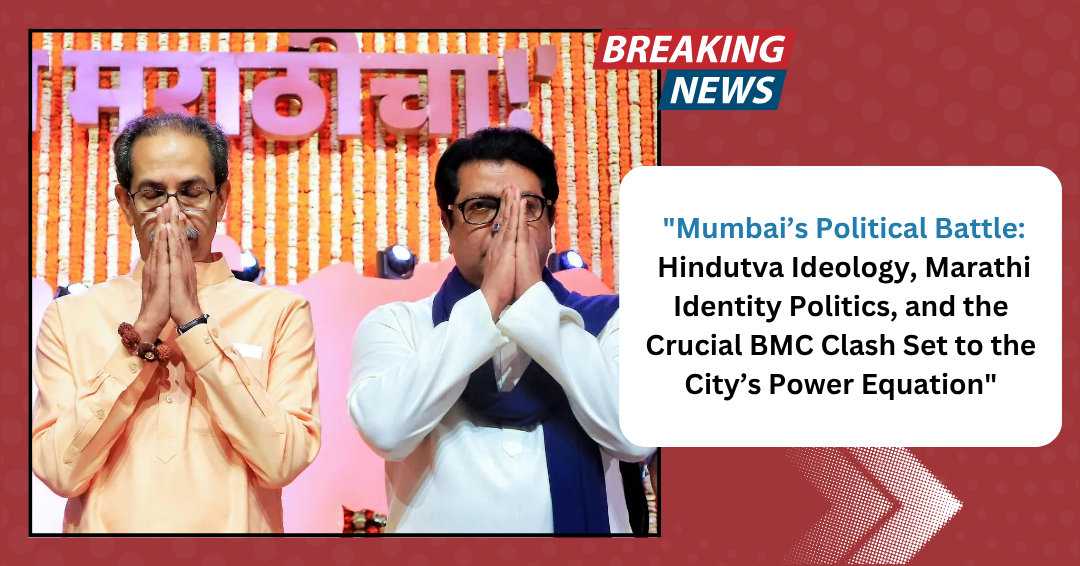
Source: HinduPost
The Marathi Manoos issue has been at the heart of Mumbai’s politics for several decades. The strong sense of linguistic and cultural identity among the Marathi-speaking native population has consistently clashed with the changing demographic and social structure of the city. This tension has largely shaped the political discourse of Mumbai. The contrast between the city’s native pride and its ever-evolving cosmopolitan character gave birth to many political ideologies, the most influential being the formation of the Shiv Sena in the 1960s.
When Shiv Sena emerged as a political force, it strongly advocated for the rights of the Bhumiputra – the Marathi Manoos, who felt alienated due to the massive influx of migrants coming to Mumbai in search of opportunities. Balasaheb Thackeray, the charismatic founder of the party, became the voice of the Marathi youth, who were instantly drawn to his fiery speeches and regional pride. However, over time, the party gradually shifted its focus from this Marathi-centric agenda to the larger idea of Hindutva, seeking to expand its influence. This ideological shift led to an electoral alliance with the Bharatiya Janata Party (BJP), beginning with the 1984 Lok Sabha elections, significantly widening Shiv Sena’s voter base beyond its Marathi stronghold.
This remained the party’s ideological direction until Balasaheb Thackeray’s death in 2012, after which leadership passed to his son, Uddhav Thackeray. The succession created internal friction, especially with Raj Thackeray, Balasaheb’s nephew, who walked out to form the Maharashtra Navnirman Sena (MNS) in 2006. The MNS strongly revived the original Marathi Manoos agenda, attempting to fill the political void created by Shiv Sena’s shift toward Hindutva. Raj’s fiery oratory, reminiscent of Balasaheb in his youth, struck a chord with voters, giving MNS an impressive debut by winning 13 seats in the 2009 Assembly elections, primarily at the cost of Shiv Sena’s vote share.
Under Uddhav Thackeray’s leadership, Shiv Sena continued drifting away from its core ideology. Despite contesting the 2019 Assembly elections with the BJP and securing a clear mandate, Uddhav chose to break the pre-poll alliance, forming a coalition government with ideological rivals. His push for a more “secular and inclusive Hindutva” alienated a significant section of Shiv Sena’s traditional voter base. Efforts to reach out to Muslim voters and promote an inclusive image confused and disappointed many loyal supporters, weakening the party’s ideological stance.
This discontent eventually triggered a major rebellion led by Eknath Shinde, who took control of the party name, leadership, and symbol. Uddhav was left with a restructured faction named Shiv Sena (Uddhav Balasaheb Thackeray) and eventually aligned with the INDIA alliance, comprising parties he had long opposed.
In a surprising twist, Uddhav recently shared a stage with his cousin Raj Thackeray, with whom he had a long-standing rivalry, celebrating the state government’s rollback of Hindi as an optional third language, calling it a “victory for Marathi Unity.” Both leaders announced their intent to stay united, raising political speculations ahead of the upcoming BMC elections.
The BMC, with its massive ₹74,000-crore budget, remains a political prize bigger than many Indian states. As elections approach, emotional appeals to the Marathi Manoos are resurfacing, but the reality remains grim – the native Marathi population in Mumbai continues to shrink, and their core concerns remain unresolved. Whether political parties genuinely care for the Marathi Manoos or merely exploit the sentiment for electoral gains is a question voters will soon answer.
Image Courtesy:
Related News
This article is based on publicly available information from credible sources (as mentioned above) and has been restructured using a combination of AI tools and manual editorial inputs to enhance clarity and readability. While we aim to maintain accuracy, there may be unintentional errors or misinterpretations. If you come across any incorrect or misleading information, please report it to us at info@bmcelections.com.
Copyright © 2026 All Rights Reserved | BMC Election