BMC Elections
- Past BMC Election Results
- Know your Booth Location
- Standing Committee Members
- BMC Elections 2017 Delimitation
- New Ward List Civic Elections 2025
- New Wards Maps for BMC Elections 2025
- BMC Election 2025 Date
- CEO Maharashtra
- Know Your BMC
- BMC News & Updates
- Wards
- Candidates
- Mumbai Corporators
- Advertise
- Contact
- Volunteer
- Privacy Policy
Mahayuti leadership confirms joint strategy to fight through two major poll rounds
- by Webdesk
- 10 Dec 2025
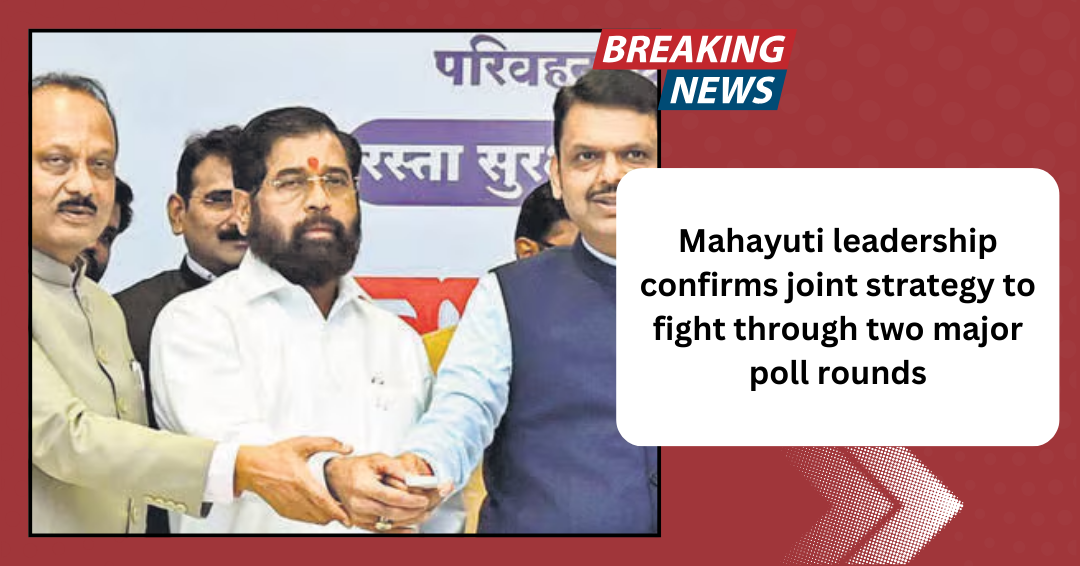
Source: Hindustan Times
NAGPUR: The first phase of the local body elections saw repeated clashes and friction within the ruling Mahayuti partners, but after weeks of internal turbulence, the Bharatiya Janata Party (BJP), Shiv Sena, and Nationalist Congress Party (NCP) have finally chosen to set aside their disputes and move forward together. The three parties have decided to jointly contest the remaining two phases of the elections, marking a significant shift in strategy. There are also strong indications that the BJP and Shiv Sena may fight the upcoming Brihanmumbai Municipal Corporation (BMC) election as a united front, with seat-sharing discussions likely to begin right after the winter Assembly session concludes.
Over the past few months, the rivalry between the BJP and Sena had intensified, as leaders from both sides attempted to draw each other’s cadre and put up opposing candidates during the municipal council and nagar panchayat elections. These moves widened the cracks between the allies and created tension on the ground. However, on Monday night, senior leaders from all three parties held a crucial closed-door meeting at chief minister Devendra Fadnavis’s residence in Nagpur. The meeting marked the first concrete effort to bring the alliance back on track for the upcoming crucial phases.
According to a Shiv Sena leader familiar with the discussions, the meeting with the chief minister ended with a clear decision—leaders from each party would refrain from attacking alliance partners publicly and would also stop encouraging defections. It was openly acknowledged in the meeting that the violence and open confrontations between alliance workers during the first phase had badly affected the government’s image. Leaders agreed that if the infighting continued, it could prove costly in the next rounds of polling.
The meeting reportedly lasted for more than ninety minutes, after which it was agreed that further discussions would now move to the local level, where detailed seat-sharing plans for each municipal corporation would be worked out. The Sena leader added that the overall atmosphere of the meeting was positive and that all three parties mutually agreed to contest the municipal corporation elections—including key cities like Mumbai and Thane—under one alliance.
Before attending the joint meeting, deputy chief minister and Shiv Sena chief Eknath Shinde had held a separate interaction with all his party MLAs at his own residence in Nagpur. The objective was to gather their views on the elections to the 29 municipal corporations, 32 district councils, and the panchayat samitis. Although several Sena MLAs expressed their dissatisfaction, particularly over the alleged unequal distribution of development funds and the treatment they received from BJP leaders during the first phase of campaigning, Shinde urged them to put their grievances aside. He stressed the importance of presenting a united alliance to secure maximum seats across the state.
Shiv Sena minister and tourism head Shambhuraj Desai reiterated that local body elections form the backbone of political influence for any party. He noted that the Sena enjoys strong grassroots support across Maharashtra and insisted that the party would work together with its allies in all forthcoming elections.
However, the sentiment was not equally shared by everyone within the BJP and NCP. A senior BJP leader pointed out that aside from Mumbai, forming a smooth alliance at the local level in other municipal corporations would be challenging. In several regions—particularly within the Mumbai Metropolitan Region (MMR)—local BJP and Sena leaders have been demanding to contest independently. There are numerous zones of direct competition when it comes to political dominance, especially in Thane, Mira-Bhayandar, Navi Mumbai, and Kalyan-Dombivli. Even if the alliance is maintained, negotiating seat-sharing will remain one of the toughest hurdles. The BJP leader mentioned that while the alliance would be preserved in as many corporations as possible, the situation in district councils might be different, as the BJP holds stronger ground there compared to the Sena and NCP.
Meanwhile, the NCP leadership also expressed concerns about how the alliance would function uniformly across different regions. The varying strengths of each party across districts add complexity to a seamless seat-sharing arrangement.
As of now, the elections for district councils and municipal corporations are expected to take place in January, divided into two phases. With the ruling partners attempting to rebuild unity, much will depend on how effectively they manage the grassroots negotiations, resolve local disputes, and maintain discipline among their cadres.
Image Courtesy:
Related News
This article is based on publicly available information from credible sources (as mentioned above) and has been restructured using a combination of AI tools and manual editorial inputs to enhance clarity and readability. While we aim to maintain accuracy, there may be unintentional errors or misinterpretations. If you come across any incorrect or misleading information, please report it to us at info@bmcelections.com.
Copyright © 2026 All Rights Reserved | BMC Election