BMC Elections
- Past BMC Election Results
- Know your Booth Location
- Standing Committee Members
- BMC Elections 2017 Delimitation
- New Ward List Civic Elections 2025
- New Wards Maps for BMC Elections 2025
- BMC Election 2025 Date
- CEO Maharashtra
- Know Your BMC
- BMC News & Updates
- Wards
- Candidates
- Mumbai Corporators
- Advertise
- Contact
- Volunteer
- Privacy Policy
Maharashtra Local Body Polls 2025: SEC pushes voter list deadlines for 29 municipal corporations; final roll to be released on December 27
- by Webdesk
- 09 Dec 2025
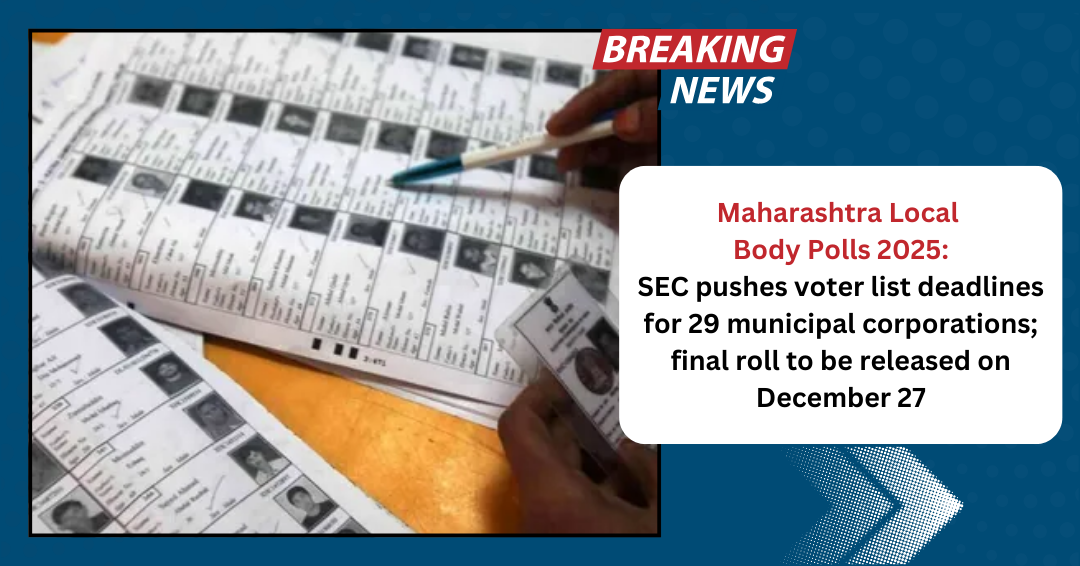
Source: Free Press Journal
The Maharashtra State Election Commission (SEC) on Tuesday unveiled a revised timeline for the drafting and publication of electoral rolls for the upcoming elections to 29 municipal corporations across the state. The update arrives at a time when several civic bodies have reported delays, errors, and software-related difficulties in compiling accurate voter records, prompting the need for an extension.
Provisional Voter List Pushed to December 15
Under the new schedule, the release of the ward-wise provisional voter list—initially slated for December 10—has now been moved to December 15. This revised timeline also applies to the authentication of the list and the incorporation of corrections based on objections raised by citizens. All these steps are now expected to be completed on the same extended date. Election officials stated that since many civic bodies were still grappling with pending corrections, data mismatches, and internal voter roll adjustments, the earlier deadline had become unachievable. The new date aims to give them adequate time to finalize accurate ward-wise entries before further stages of the election process commence.
Polling Station List Rescheduled to December 20
In addition to the delay in publishing the provisional list, the SEC has also shifted the schedule for preparing the list of polling stations. Previously expected to be released by December 15, the polling station list will now be published on December 20. Following that, the polling station–wise final electoral roll, which was initially set for December 22, will now be made available on December 27.
According to election officials, these changes were essential to ensure uniformity and avoid overlap in tasks, as multiple municipal bodies struggled with technical constraints and backlogs. With the extended timeline, the commission intends to allow local bodies enough breathing room to verify data meticulously instead of rushing through crucial voter information.
Technical Support Offered to Municipal Bodies
An SEC representative highlighted that all civic bodies have been instructed to immediately contact the commission’s computerisation department via email or phone should they encounter technical errors, software malfunctions, or system-level interruptions during the voter list preparation process. The commission has assured continuous technical support to prevent delays caused by digital glitches.
Revision Based on Civic Bodies’ Requests
State Chief Election Commissioner Dinesh Waghmare explained that the decision to alter the timeline was taken after a detailed review meeting with municipal commissioners across Maharashtra. Many bodies, he said—particularly Pune and Kolhapur—had explicitly sought an extension because major segments of their voter list compilation work were unfinished. Commissioner Waghmare indicated that the SEC preferred to accept these requests rather than risk inaccuracies or incomplete records. Ensuring a dependable and error-free voter database, he emphasized, is essential before advancing to the next stages of the municipal electoral process.
Rectification of Entries Remains the Most Difficult Task
One of the main reasons for the delay, according to Waghmare, is the extensive rectification work required in the voter lists. These corrections include shifting names to appropriate wards, fixing spelling mistakes, updating gender details, and making sure entries reflect the correct addresses.
He noted that these tasks require precision and are time-intensive, as even minor inaccuracies can create confusion for voters on election day. Because of the detailed nature of this work, the commission felt that granting additional time was the most practical and responsible move.
New Software Launched to Detect Duplicate Entries
With concerns rising over duplicate voter entries, the SEC has also introduced a dedicated software tool designed to match photographs with name-based search results, thereby simplifying the verification of suspected duplicate records. This tool has already been provided to most municipal corporations.
Mumbai is the only exception because the Brihanmumbai Municipal Corporation (BMC) has independently developed its own system that not only identifies duplicate entries but also displays associated photographs for cross-checking.
Mumbai’s Verification Effort Underway; Pune Leads in Duplicate Cases
Mumbai, which has more than one crore registered voters, is currently in the process of cross-verifying its voter rolls. Preliminary estimates from SEC officials suggest that nearly seven percent of entries could be duplicates, necessitating a detailed verification drive. On a statewide scale, Pune has emerged as the region with the highest number of detected duplicate entries. Officials are working intensively to clean up the lists before the final publication date.
Image Courtesy:
Related News
This article is based on publicly available information from credible sources (as mentioned above) and has been restructured using a combination of AI tools and manual editorial inputs to enhance clarity and readability. While we aim to maintain accuracy, there may be unintentional errors or misinterpretations. If you come across any incorrect or misleading information, please report it to us at info@bmcelections.com.
Copyright © 2026 All Rights Reserved | BMC Election