BMC Elections
- Past BMC Election Results
- Know your Booth Location
- Standing Committee Members
- BMC Elections 2017 Delimitation
- New Ward List Civic Elections 2025
- New Wards Maps for BMC Elections 2025
- BMC Election 2025 Date
- CEO Maharashtra
- Know Your BMC
- BMC News & Updates
- Wards
- Candidates
- Mumbai Corporators
- Advertise
- Contact
- Volunteer
- Privacy Policy
Maharashtra District Council Elections: Political heat rises as uncertainty over poll dates continues
- by Webdesk
- 29 Nov 2025
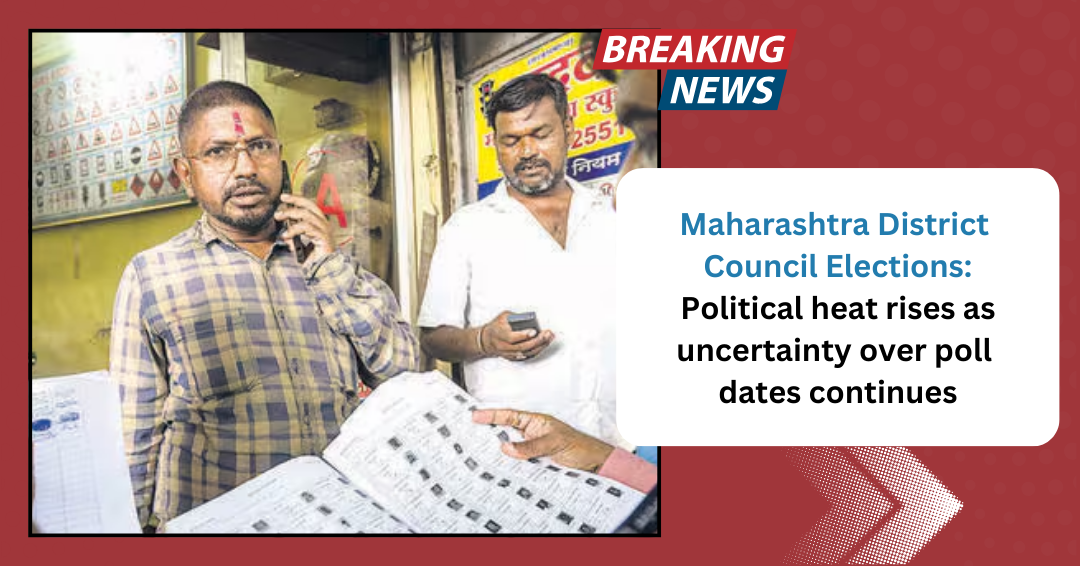
Source: Hindustan Times
Mumbai: The Supreme Court’s interim order delivered on Friday on Maharashtra’s stalled local body elections has once again cast uncertainty over the timeline for the district council and panchayat samiti polls. Following the order, officials within the State Election Commission (SEC) indicated that they may now shift the municipal corporation elections to the second phase and push the district council and panchayat samiti elections to the final phase so that more time is available to resolve the legal dilemmas surrounding reservation limits.
In its order, the Supreme Court gave the SEC permission to conduct elections for 246 municipal councils and 42 nagar panchayats on December 2 as per the earlier schedule. At the same time, the court instructed that the results of 57 of these bodies—where the 50 percent ceiling on reservation has been crossed—would not be finalized until the Supreme Court delivers its final verdict in the case. Similarly, the Supreme Court also allowed the SEC to conduct elections for all 29 municipal corporations across the state as originally planned. However, for the Nagpur and Chandrapur municipal corporations, the results of the elections will be kept on hold and declared only after the court issues its conclusive ruling.
The prevailing uncertainty is specifically linked to 32 district councils and 336 panchayat samitis. The court has clarified that elections may proceed only in those bodies where the reservation has not crossed the 50 percent cap. In the list presented before the court, 17 district councils and 84 panchayat samitis have been found to have breached this limit. This has created confusion for both the election machinery and political parties preparing for the polls. Earlier, on November 4, the SEC had announced a clear three-phase election sequence. Elections for municipal councils and nagar panchayats were scheduled as the first phase on December 2, followed by district council and panchayat samiti elections in the last week of December under the second phase, and municipal corporation elections scheduled in the third week of January under the third phase. However, the interim Supreme Court order has now disrupted only the second and third phases, while the first phase for municipal councils and nagar panchayats remains unchanged.
Although the SEC is moving ahead with the December 2 polling, the uncertainty surrounding the district council and panchayat samiti elections continues because the order does not make it clear whether the reservation can be modified within a short span of time so that these bodies can also go to polls. An SEC official, without revealing his identity, stated that the commission is waiting to consult its legal advisors before deciding whether the bodies that exceed the quota can be brought within the 50 percent boundary immediately. He added that the SEC will take a definite stand next week. Another official said that the commission is unlikely to approach the Supreme Court again for clarification and may wait for petitioners to do so on their own. In the meantime, the SEC is considering altering the election schedule by shifting the municipal corporation elections to the second phase in the first or second week of January, and scheduling district council and panchayat samiti elections as the final phase toward the end of January. He highlighted that the SEC is legally required to complete the elections in all three phases by January 31, and by swapping the second and third phases, the commission will gain more time to resolve the disputes over reservation. If it is not possible to change the reservations in time, then the SEC may conduct elections only for those district councils and panchayat samitis that already comply with the 50 percent reservation limit.
Meanwhile, Advocate Devdatt Palodkar, representing petitioner Rahul Ramesh Wagh, pointed out that the Supreme Court order already allows the SEC to carry out elections for the district councils and panchayat samitis that fall within the reservation limit. He also mentioned that in several bodies, the ceiling has been exceeded only in one or two constituencies, and adjusting these reservations may not require excessive time. Yet, petitioner Vikas Gawali expressed disappointment that the Supreme Court did not deliver a decisive judgment that would resolve the situation for all bodies immediately. He said that the looming uncertainty regarding elected representatives from bodies that cross the reservation limit will remain until the final judgment is delivered. According to him, if the court later invalidates elections for such bodies—similar to what occurred five years ago—it will result in injustice for the winning candidates and their voters.
As Maharashtra waits for the SEC’s revised election calendar, political parties, candidates, and administrative officials remain on edge. While the Supreme Court has permitted the election process to move forward, the ambiguity surrounding reservation compliance has left the second and third phases of the election cycle in suspense. Until a legal resolution is reached or the SEC finalizes its election strategy, the district council and panchayat samiti polls will continue to remain in a state of uncertainty.
Image Courtesy:
Related News
This article is based on publicly available information from credible sources (as mentioned above) and has been restructured using a combination of AI tools and manual editorial inputs to enhance clarity and readability. While we aim to maintain accuracy, there may be unintentional errors or misinterpretations. If you come across any incorrect or misleading information, please report it to us at info@bmcelections.com.
Copyright © 2026 All Rights Reserved | BMC Election