BMC Elections
- Past BMC Election Results
- Know your Booth Location
- Standing Committee Members
- BMC Elections 2017 Delimitation
- New Ward List Civic Elections 2025
- New Wards Maps for BMC Elections 2025
- BMC Election 2025 Date
- CEO Maharashtra
- Know Your BMC
- BMC News & Updates
- Wards
- Candidates
- Mumbai Corporators
- Advertise
- Contact
- Volunteer
- Privacy Policy
Local Body Elections to Proceed with 27% OBC Quota, 2017 Ward Boundaries Backed by SC
- by Webdesk
- 05 Aug 2025
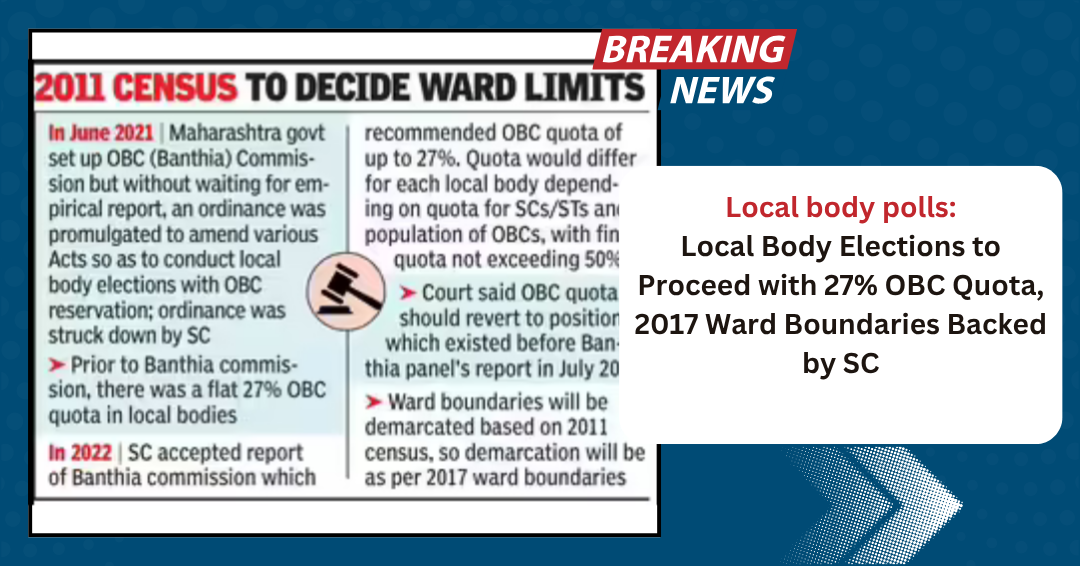
Source: The Times Of India
The Supreme Court has cleared the way for local body elections in Maharashtra with 27% reservation for the Other Backward Classes (OBCs). On Monday, the apex court upheld its earlier decision dated May 6, confirming the implementation of OBC reservation and endorsing the use of the 2017 ward boundaries. The court also instructed the State Election Commission (SEC) to release the election notification within four weeks. This decision came in response to a petition filed against the restructured ward layout of the Ausa Municipal Council in Latur district. The petitioners had demanded that the delimitation be reversed to the structure prior to March 2022. However, the Supreme Court clarified that defining ward boundaries is solely the authority of the state government.
The court dismissed pleas requesting a return to the earlier ward division implemented during the Maha Vikas Aghadi (MVA) regime, which had added new wards based on projected population data. The top court made it clear that the upcoming local body polls would be held according to the ward configuration approved by the present state government. Additionally, the court rejected a separate petition that challenged the 27% OBC reservation in local bodies, thereby reaffirming its earlier ruling that elections could proceed with the reservation in place.
Deputy Chief Minister Devendra Fadnavis welcomed the court’s ruling and said the state government’s stand had been accepted on both key issues — the 2017 ward demarcation and the reservation for OBCs. “The petition had demanded that the ward formation done in 2022 under the MVA be retained. However, our government had already revoked that decision and proposed reverting to the 2017 format. This stance has now been validated by the court,” he stated. Fadnavis further added that the Supreme Court’s ruling has reinforced the earlier direction allowing the implementation of 27% OBC reservation across all districts in the state. He emphasized that the verdict brings clarity to the long-delayed election process.
Previously, during hearings on the same matter, the Supreme Court had expressed dissatisfaction over the significant delay in holding local body elections. The bench had even questioned the intentions of the State Election Commission in postponing the process. In its May 6 ruling, the court had directed that the elections must be completed within four months.
Deputy CM Fadnavis had earlier laid out the state’s election strategy, announcing that polls would be held in phases. Zilla Parishad elections would be conducted in the first phase, followed by Nagar Parishads and Nagar Panchayats in the second, and finally Municipal Corporations in the third phase. The full election cycle is likely to conclude before the end of this year.
Senior NCP leader and state minister Chhagan Bhujbal also appreciated the court’s verdict, describing it as a landmark decision. “This judgment removes all remaining obstacles in the path of implementing OBC reservation in local self-governance bodies,” he said. He added, “The ruling affirms that elections will proceed based on the newly notified ward boundaries, as outlined in the May 2025 directive, and ensures the 27% OBC quota will remain intact.”
The term of the Brihanmumbai Municipal Corporation (BMC) officially ended in March 2022. Since then, the BMC has been functioning under an appointed administrator. Similar situations have unfolded in numerous civic bodies across the state. Elections have been pending in 29 municipal corporations, 248 municipal councils, 42 nagar panchayats, 32 zilla parishads, and 336 panchayat samitis.
Initially, the elections were postponed due to the Covid-19 pandemic. However, once the health crisis eased, legal battles over OBC reservation and the restructuring of ward boundaries further prolonged the electoral process. With the Supreme Court's recent decision, these obstacles have been removed, paving the way for democratic processes to resume across local bodies in Maharashtra.
Image Courtesy:
Related News
This article is based on publicly available information from credible sources (as mentioned above) and has been restructured using a combination of AI tools and manual editorial inputs to enhance clarity and readability. While we aim to maintain accuracy, there may be unintentional errors or misinterpretations. If you come across any incorrect or misleading information, please report it to us at info@bmcelections.com.
Copyright © 2026 All Rights Reserved | BMC Election