BMC Elections
- Past BMC Election Results
- Know your Booth Location
- Standing Committee Members
- BMC Elections 2017 Delimitation
- New Ward List Civic Elections 2025
- New Wards Maps for BMC Elections 2025
- BMC Election 2025 Date
- CEO Maharashtra
- Know Your BMC
- BMC News & Updates
- Wards
- Candidates
- Mumbai Corporators
- Advertise
- Contact
- Volunteer
- Privacy Policy
In Mumbai, BMC receives a massive response — 769 suggestions and objections to the draft voters' list in just 6 days
- by Webdesk
- 26 Nov 2025
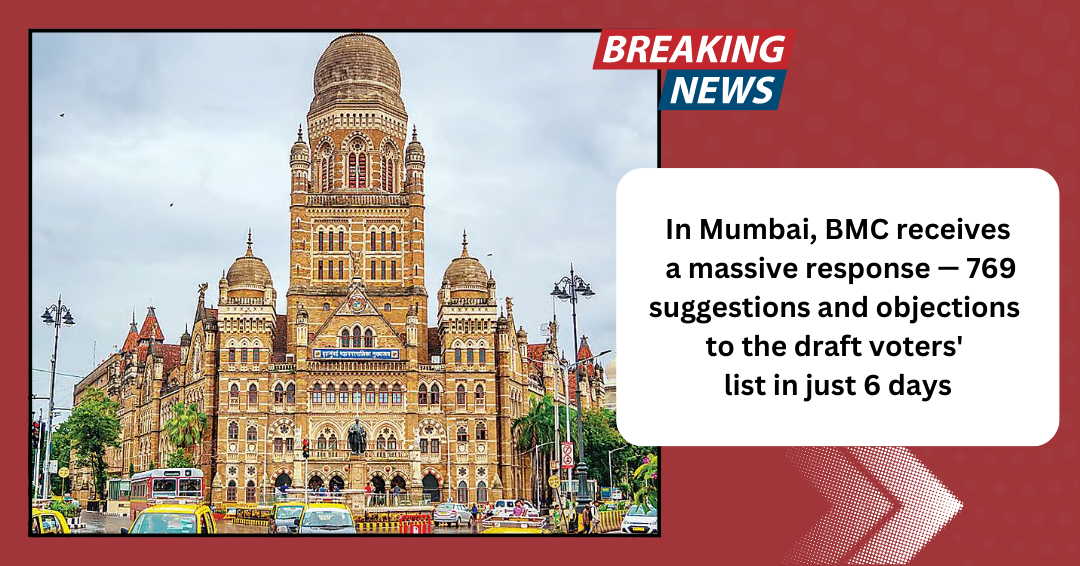
Source: The Times Of India
Mumbai: Between November 20 and November 26, the Brihanmumbai Municipal Corporation (BMC) has witnessed a notable level of public engagement toward the ward-wise draft electoral roll. During this short six-day window, the civic body collected a cumulative 769 suggestions and objections from Mumbai residents. These submissions reflect both corrections requested by citizens and concerns raised about names missing or wrongly listed in the draft electoral roll.
What is striking is the uneven distribution of these responses across the city. Some wards have reported an overwhelming number of submissions, while others show little to no participation. According to civic records, the eastern and northeastern zones of Mumbai have been the most proactive, indicating a heightened awareness of the electoral process in those regions.
At the top of the chart stands M-East ward, which includes Govandi, registering 204 suggestions and objections — the highest among all wards. This significant figure underlines the active role taken by residents there, possibly due to high population density and strong public interest in ensuring correct voter representation.
The T ward, covering Mulund, comes in second with 123 total submissions. The response from Mulund also highlights the vigilance of citizens in the suburban belt. These two wards together contribute almost half of all submissions received so far.
Beyond these, several other wards have also shown considerable involvement.
The L ward — comprising Kurla and Chunabhatti — recorded 56 submissions, demonstrating a conscious effort to rectify or update voter information. Similarly, the H-East ward (Bandra East, Khar East, and Santacruz East) logged 43 suggestions and objections, suggesting that residents in the upscale belt are also keen on accuracy in the draft list.
The K-East ward, consisting of Vile Parle East, Andheri East, and Jogeshwari East, reported 35 responses, while H-West ward — representing Bandra West, Khar West, and Santacruz West — registered 23 submissions. Although comparatively lower than the eastern and northeastern belts, these figures still portray meaningful participation in the western neighbourhoods.
However, when placed against these high-activity areas, a stark contrast becomes visible. Some wards have recorded negligible or zero participation, raising questions about awareness, accessibility, or confidence among residents.
For instance, B ward (Dongri and nearby pockets) has not received a single suggestion or objection, making it the only ward with zero involvement so far. Whether this indicates satisfaction with the electoral roll or lack of attention to the process remains unclear.
On the lower end of the scale, F-North ward (which includes Matunga and King Circle) has managed to receive only one submission to date. Meanwhile, A ward — covering Colaba, Cuffe Parade, Nariman Point, Churchgate, and Fort — reported just two responses. Even C ward — spanning areas like Bhuleshwar, Marine Lines, and Dhobi Talao — registered merely three submissions.
These wide variations in citizen participation from ward to ward highlight a bigger picture — that awareness, engagement, and interest in the electoral roll correction drive differ drastically across Mumbai. Areas that have historically shown civic enthusiasm seem to be responding more actively, while others remain largely silent. According to civic observers, multiple reasons could be contributing to this regional imbalance. In densely populated and politically sensitive zones, residents may be more vigilant about voter rolls due to previous incidents of errors or exclusions. Meanwhile, in more affluent or older neighbourhoods, there might be a belief that the lists are accurate, or residents may not have noticed the civic notifications regarding the draft publication. Social outreach and grassroots mobilisation in certain wards could also be encouraging higher participation.
The BMC has encouraged all eligible voters to scrutinize the draft electoral roll carefully. Suggestions and objections play a crucial role in preparing a final voters’ list that is error-free, up-to-date and representative of every eligible citizen. Residents are being urged to review their names, spellings, addresses, and ward allocations to avoid issues during voting day.
As the submission window progresses, the civic body is expected to intensify awareness campaigns — particularly in wards where the response has been low. The goal is to ensure that the final electoral roll mirrors the city’s population accurately before the much-anticipated civic elections.
In the weeks ahead, the pattern of submissions from various wards will likely serve as an indicator of both voter readiness and civic consciousness across Mumbai. For now, the first six days demonstrate that while many regions are proactive in safeguarding their electoral rights, others still lag behind — reflecting a varied civic engagement landscape within the same metropolis.
Image Courtesy:
Related News
This article is based on publicly available information from credible sources (as mentioned above) and has been restructured using a combination of AI tools and manual editorial inputs to enhance clarity and readability. While we aim to maintain accuracy, there may be unintentional errors or misinterpretations. If you come across any incorrect or misleading information, please report it to us at info@bmcelections.com.
Copyright © 2026 All Rights Reserved | BMC Election