BMC Elections
- Past BMC Election Results
- Know your Booth Location
- Standing Committee Members
- BMC Elections 2017 Delimitation
- New Ward List Civic Elections 2025
- New Wards Maps for BMC Elections 2025
- BMC Election 2025 Date
- CEO Maharashtra
- Know Your BMC
- BMC News & Updates
- Wards
- Candidates
- Mumbai Corporators
- Advertise
- Contact
- Volunteer
- Privacy Policy
Cousins in Politics Again: Strategic Alliance or Just a PR Gimmick Ahead of BMC Elections?
- by Webdesk
- 27 Jul 2025
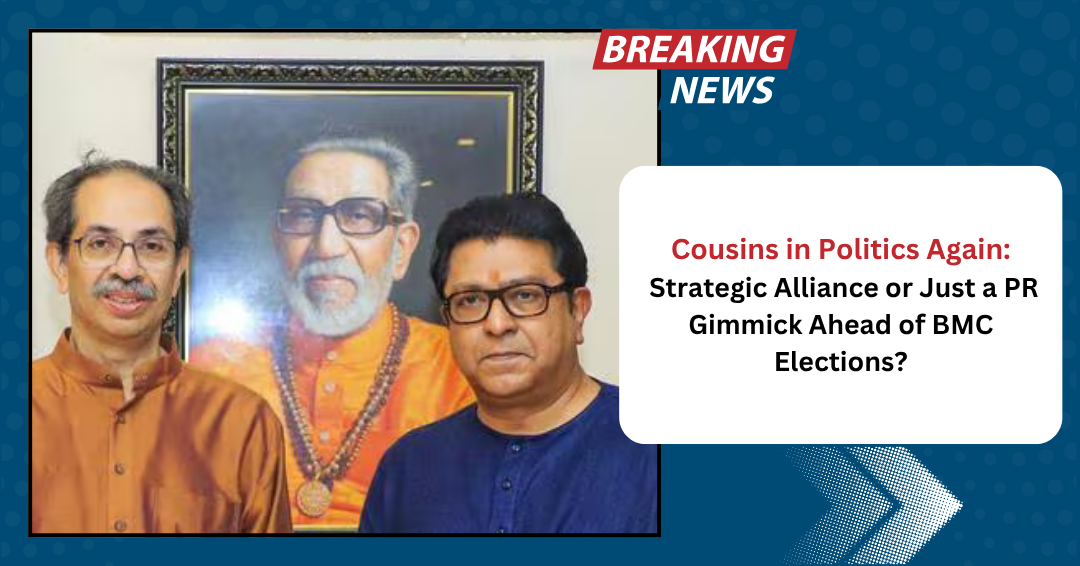
Source: The Times Of India
NEW DELHI: Is the much-talked-about reunion between Uddhav and Raj Thackeray a clever political move or simply an act of desperation amid Maharashtra’s evolving political landscape? Once commanding immense political capital, both cousins now face challenges in holding their ground as politics in the state becomes increasingly fragmented and competitive.
Uddhav Thackeray, after losing his party’s original name and symbol to Eknath Shinde, has struggled to regain momentum following poor performances in recent assembly and parliamentary elections. Raj Thackeray, despite his promising start under Balasaheb's shadow, has remained largely peripheral over the past two decades. His party, MNS, couldn’t build a sustainable support base, and even his son Amit Thackeray's electoral debut in Mahim ended in defeat at the hands of a Shiv Sena (UBT) candidate.
Recently, Raj paid a visit to Uddhav at his residence, Matoshree, to wish him on his birthday. This seemingly simple gesture, coming shortly after their joint appearance at the 'Awaz Marathicha' rally, has reignited talks of a potential political understanding. Many see this public warmth as the beginning of a strategic realignment ahead of the crucial BMC elections.
The BMC, India’s wealthiest civic body, has long been a bastion of Shiv Sena. Since 2002, the party has consistently emerged as the single-largest force. From 97 seats in 2002 to 84 in 2007 and then 75 in 2012, the party maintained control with the BJP's support. Even in 2017, amidst a tight contest where BJP secured 82 seats against Sena's 84, the latter retained dominance.
But times have changed. With BJP gaining ground across Maharashtra and Shiv Sena now led by Eknath Shinde, the upcoming civic polls are crucial for the Thackeray cousins. For Uddhav, especially, it's about political survival and reclaiming relevance in Mumbai’s dynamic arena.
Following Shinde’s 2022 rebellion, Uddhav lost not just the CM’s chair but also his party’s identity and a sizable chunk of loyal cadre. Shinde’s image as a grounded, non-dynastic leader has resonated with voters, further weakening Uddhav’s appeal. Despite aligning with the Congress and NCP, Uddhav’s political returns have diminished, and his hold over Mumbai seems shakier than ever.
Raj Thackeray, who left Shiv Sena in 2005 after being sidelined, saw early traction with his Marathi-centric rhetoric. However, MNS couldn’t sustain that momentum. Attempts to revive the party, including his son’s political debut and potential BJP alliances, failed to materialize into substantial gains.
Raj's recent aggressive speeches, echoing Balasaheb’s fiery tone, appear designed to stoke Marathi pride and reinvigorate his support base. Statements like "dooba dooba ke maarenge" and open defense of MNS workers accused in anti-migrant incidents are attempts to revive the identity politics that once shaped Mumbai. However, with changing demographics and shifting voter priorities, such hardline stances may not resonate as they once did.
In this context, Raj's growing proximity to Uddhav seems like a calculated attempt to reposition himself within the state’s political theatre. Though not officially an alliance, their public appearances hint at a trial partnership. This collaboration might not guarantee electoral wins but certainly ensures both remain relevant in the political discourse.
Interestingly, while Uddhav has warmed up to CM Devendra Fadnavis of BJP in recent months, speculation is rife about a possible return to the NDA. Such a move could shake up the current power balance, especially if Shinde underperforms in the BMC elections.
Shinde, though still commanding numbers, finds his influence diluted after Ajit Pawar's entry into the NDA. His grip on the alliance no longer appears unshakeable, and a poor show in BMC elections could make him dispensable. This would open the door for Uddhav’s return and possibly strengthen Raj’s hand in reshaping the Marathi narrative in Mumbai.
Ultimately, the BMC elections could redefine the future of the Thackeray cousins. Whether this renewed camaraderie is the beginning of a serious political comeback or just a symbolic gesture in a moment of political crisis remains uncertain. One thing is clear: Maharashtra's political winds are shifting, and the outcome of the civic polls could write a significant new chapter in this enduring family saga.
Image Courtesy:
Related News
This article is based on publicly available information from credible sources (as mentioned above) and has been restructured using a combination of AI tools and manual editorial inputs to enhance clarity and readability. While we aim to maintain accuracy, there may be unintentional errors or misinterpretations. If you come across any incorrect or misleading information, please report it to us at info@bmcelections.com.
Copyright © 2026 All Rights Reserved | BMC Election