BMC Elections
- Past BMC Election Results
- Know your Booth Location
- Standing Committee Members
- BMC Elections 2017 Delimitation
- New Ward List Civic Elections 2025
- New Wards Maps for BMC Elections 2025
- BMC Election 2025 Date
- CEO Maharashtra
- Know Your BMC
- BMC News & Updates
- Wards
- Candidates
- Mumbai Corporators
- Advertise
- Contact
- Volunteer
- Privacy Policy
City gridlock: Demonstrators camp, cook, and defecate on roads; civic body boosts facilities
- by Webdesk
- 01 Sep 2025
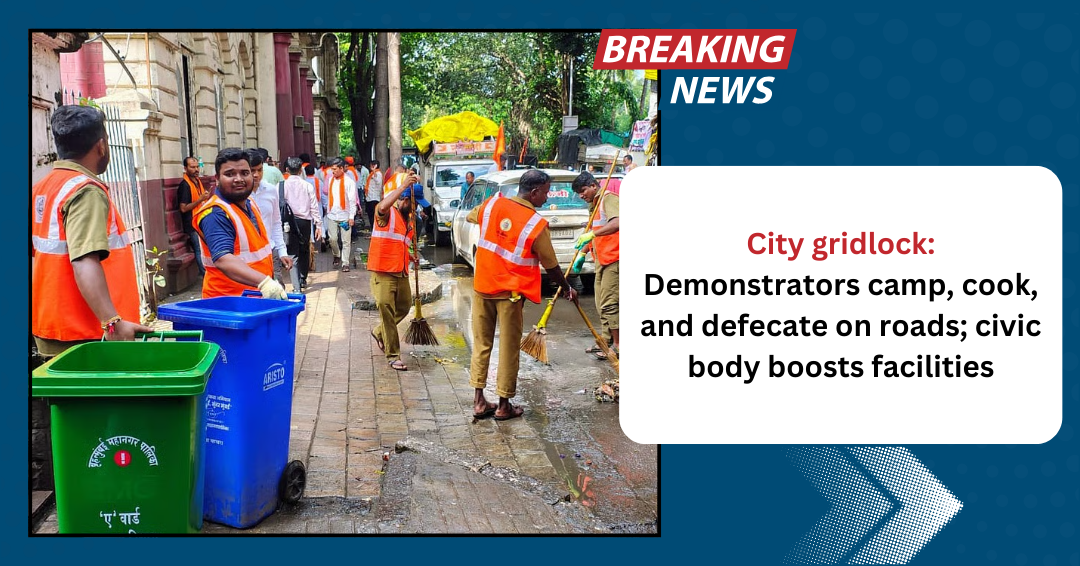
Source: The Times Of India
MUMBAI: The CSMT area and nearby streets were completely overtaken by protesters and their vehicles over the weekend, bringing life in south Mumbai’s commercial hubs to a near standstill. Businesses around Crawford Market reported heavy losses, as weekend shoppers avoided the area out of fear. Traders said festival-related shopping, which usually peaks at this time, was badly hit.
A motorist narrated his ordeal, saying that his vehicle was surrounded by a large crowd near CSMT. The mob reportedly banged on the bonnet and windows while chanting slogans, leaving him and his family shaken.
The protesters, who arrived in massive numbers, converted roads into temporary living spaces. They were seen cooking food, washing clothes, and even bathing in public, with garments hung out to dry on traffic signals. Food packets lay scattered on the streets, creating an eyesore and adding to sanitation issues. To cope, the Brihanmumbai Municipal Corporation (BMC) deployed more workers, set up additional dustbins, and enforced round-the-clock shifts to manage the growing piles of waste.
Businesses and daily life disrupted
Garbage heaps piled up as protesters filled every corner of the CSMT zone. Many motorists avoided travelling to south Mumbai, worsening the impact on local businesses. Shops in Crawford Market, Kala Ghoda, and Colaba saw reduced footfall, with some shutting earlier than usual. Eyewitnesses reported that some protesters even walked into a luxury hotel in Colaba and a popular clothing store in Kala Ghoda carrying banners. They allegedly used the hotel’s washrooms and rested in the lobby before leaving. Several restaurants in the area also downed shutters early, unwilling to deal with the disturbance.
Locals complained of foul odours in the area as several protesters relieved themselves against walls of public buildings. Despite civic authorities’ efforts to arrange mobile toilets, open urination continued, enveloping parts of south Mumbai in a stench.
Civic body overwhelmed
The BMC initially estimated that around 5,000 protesters would gather at Azad Maidan. However, the turnout surged to nearly 30,000 over three days, forcing the civic body into crisis mode. On the first day, shortages were evident: too few water tankers and toilets created hardship for demonstrators. By day three, however, the BMC expanded services drastically.
The number of water tankers was raised from just six to 25. Similarly, sanitation and cleaning staff strength was boosted from 119 to 1,125, with workers pulled in from four extra wards. The BMC also tackled garbage management urgently—100 additional dustbins were placed across the affected zones, and staff were deployed in three daily shifts to keep up with the waste generation.
Medical and hygiene measures
Portable sanitation facilities saw major upgrades as well. Initially, 236 portable toilets and 40 mobile units were installed at Azad Maidan. On Sunday, another 50 toilets were added at the site, along with 60 units at the Mumbai Port area.
Medical facilities were strengthened in parallel. The BMC stationed four ambulances, four medical teams, and set up a 24/7 health desk. Nair Hospital sent its team to the protest site, while hospitals including GT, JJ, Bombay, KEM, Nair, and St George kept emergency beds ready. Officials said over 1,000 protesters had already been treated for minor ailments ranging from dehydration to infections.
The rains compounded problems by turning Azad Maidan muddy. To improve access, two truckloads of stones were laid at entry points to level the pathways. Adequate lighting was also ensured, with three high-beam floodlights mounted on fire brigade vehicles to brighten the grounds at night.
Looking ahead
BMC officials noted that most protesters were being supplied with food packets and water bottles. Garbage bags were also distributed to discourage littering. However, given the pressure on civic resources, the administration is preparing for further reinforcements. From Monday, the BMC plans to hire an additional 500 workers on a contractual basis through a private agency.
“We have our regular ward-level teams busy with Ganpati immersion duties as well. That is why we are looking to rope in more contractual labourers to manage the protest sites,” said an official.
For now, the BMC continues to operate in emergency mode, trying to strike a balance between maintaining order, ensuring hygiene, and coping with the swelling demands of thousands of protesters camped in the city’s busiest neighbourhood.
Image Courtesy:
Related News
This article is based on publicly available information from credible sources (as mentioned above) and has been restructured using a combination of AI tools and manual editorial inputs to enhance clarity and readability. While we aim to maintain accuracy, there may be unintentional errors or misinterpretations. If you come across any incorrect or misleading information, please report it to us at info@bmcelections.com.
Copyright © 2026 All Rights Reserved | BMC Election