BMC Elections
- Past BMC Election Results
- Know your Booth Location
- Standing Committee Members
- BMC Elections 2017 Delimitation
- New Ward List Civic Elections 2025
- New Wards Maps for BMC Elections 2025
- BMC Election 2025 Date
- CEO Maharashtra
- Know Your BMC
- BMC News & Updates
- Wards
- Candidates
- Mumbai Corporators
- Advertise
- Contact
- Volunteer
- Privacy Policy
Bombay High Court : Ahead of BMC elections, Bombay High Court urges poll panel to address 18-year-old’s request amid voter rush
- by Webdesk
- 06 Nov 2025
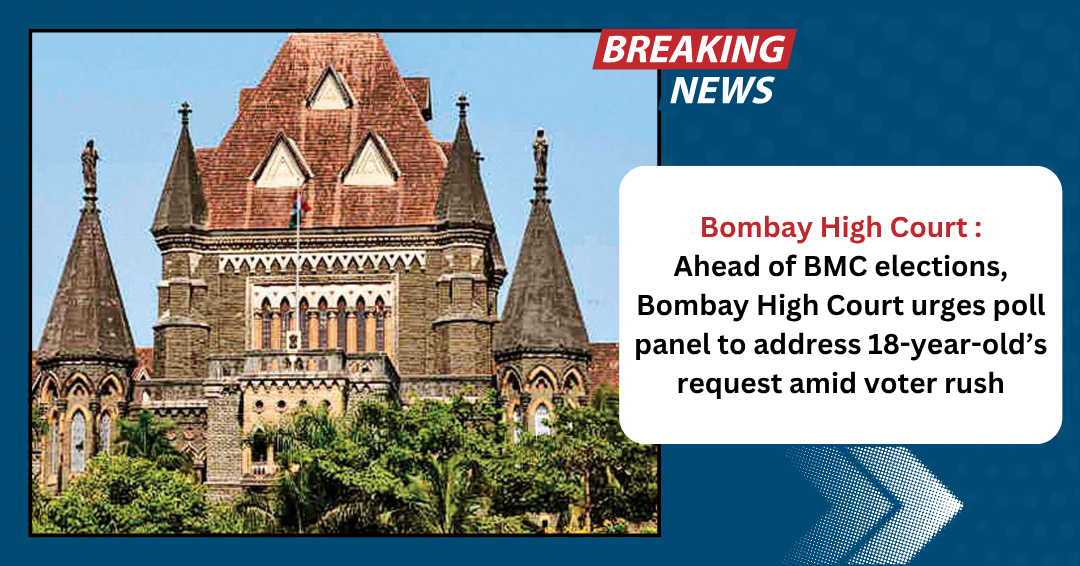
Source: The Indian Express
Mumbai: The Bombay High Court on Thursday drew a fine distinction between the “freedom to vote” and the “right to vote”, observing that if everyone began filing voter registration forms immediately upon turning 18, it could lead to an overwhelming rush and burden the election machinery. Despite this caution, the High Court directed the electoral registration officer to take a decision within six weeks on an application filed by an 18-year-old college student seeking to be enrolled as a voter. The student had approached the court claiming that although she attained the age of 18 in April this year, her application for inclusion in the electoral roll had not been accepted — a move she said violated her statutory right to vote.
The division bench of Justice Riyaz I. Chagla and Justice Farhan P. Dubash was hearing a petition filed by Rupika Singh, represented by advocate Arshil Shah. In her plea, Singh stated that she was unable to submit her voter registration form on the Election Commission (EC) website because there was no specific option for residents of Maharashtra who turned 18 on or after October 2, 2024, to select their date of birth.
When she approached election officials for clarification, Singh was informed that October 1, 2024, was the cut-off date for voter enrolment in Maharashtra. As a result, she could apply only after the EC revised the date in the next update of the electoral rolls.
However, in September 2025, Singh discovered through media reports that the EC had notified July 1, 2025, as the new cut-off date for voter registration in the state. This meant that those who turned 18 between October 1, 2024, and July 1, 2025, including herself, would not be eligible to cast their vote in the upcoming Brihanmumbai Municipal Corporation (BMC) elections.
The revelation, she said, left her “deeply disappointed and shocked.” Singh argued that the decision effectively disenfranchised thousands of newly eligible voters across Maharashtra, denying them participation in a key democratic process.
The petitioner further mentioned that despite repeated attempts — including contacting election officials, visiting registration booths, and submitting written representations to the Chief Electoral Officer (CEO) — she could not obtain any satisfactory redressal. Left with no other remedy, she decided to move the Bombay High Court seeking justice.
In her argument, Singh contended that the rejection of her voter application violated her freedom of expression, as the right to vote represents a fundamental mode of political participation. However, the bench drew attention to a previous Supreme Court judgment, clarifying that there exists a constitutional distinction between freedom to vote and right to vote.
The court observed that while every citizen enjoys the freedom to vote upon reaching the age of 18, the legal right to vote only comes into existence when the person’s name appears in the electoral roll. The bench orally remarked, “If every person starts submitting applications the moment they turn 18, it will open floodgates and overwhelm the election system.”
This comment highlighted the court’s concern about managing the administrative load that could arise if the EC were required to process large numbers of applications continuously throughout the year.
Nonetheless, after considering the petitioner’s situation, the court suggested that the election authorities could still review and take an appropriate decision on her application. Responding to this suggestion, Senior Advocate Ashutosh Kumbhakoni, appearing for the Chief Electoral Officer of Maharashtra, informed the bench that the CEO’s office was willing to consider the request.
Taking his statement on record, the bench then directed the electoral registration officer to decide on Singh’s voter registration application within six weeks. With this direction, the court disposed of the plea.
The case brings into focus the recurring confusion faced by first-time voters about cut-off dates and eligibility windows for enrolment, especially before major civic and assembly elections. Legal experts note that while the EC follows a fixed schedule for updating electoral rolls, greater transparency and accessibility could prevent young citizens from being unintentionally excluded from the democratic process.
The judgment also reiterates that the freedom to vote is a broad democratic principle available to all adults, but the right to vote is conferred only through proper inclusion in the electoral register — a distinction that has often been the subject of legal and constitutional debate.
With the Bombay High Court’s directive, the Election Commission will now have to take a formal decision on the young petitioner’s application, potentially setting a precedent for how similar cases involving first-time voters are handled before upcoming local body elections.
Image Courtesy:
Related News
This article is based on publicly available information from credible sources (as mentioned above) and has been restructured using a combination of AI tools and manual editorial inputs to enhance clarity and readability. While we aim to maintain accuracy, there may be unintentional errors or misinterpretations. If you come across any incorrect or misleading information, please report it to us at info@bmcelections.com.
Copyright © 2026 All Rights Reserved | BMC Election