BMC Elections
- Past BMC Election Results
- Know your Booth Location
- Standing Committee Members
- BMC Elections 2017 Delimitation
- New Ward List Civic Elections 2025
- New Wards Maps for BMC Elections 2025
- BMC Election 2025 Date
- CEO Maharashtra
- Know Your BMC
- BMC News & Updates
- Wards
- Candidates
- Mumbai Corporators
- Advertise
- Contact
- Volunteer
- Privacy Policy
BMC’s Temporary Pigeon-Feeding Zone at Airoli–Mulund Check Naka Faces Legal Challenge in High Court
- by Webdesk
- 20 Nov 2025
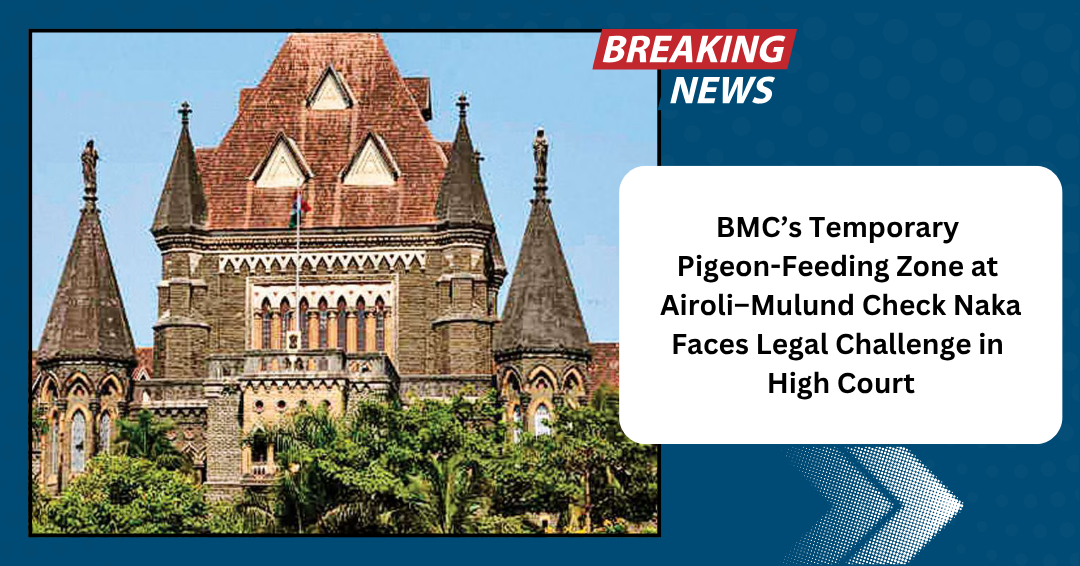
Source: Hindustan Times
MUMBAI: A fresh interim application was submitted before the Bombay High Court on Wednesday challenging the BMC’s decision to set up a temporary pigeon-feeding zone along the creekside stretch near the old Airoli–Mulund check naka. The plea, filed by petitioner Sagar Devre, criticizes the civic administration’s move as “irrational” and raises strong concerns about public safety as well as ecological harm that could result from such an arrangement.
According to the petition, the high court had earlier imposed a ban on feeding pigeons in public places across Mumbai due to grave health hazards posed by their droppings and feathers. Following the ban, the BMC introduced an interim arrangement under which people were permitted to feed pigeons only at four controlled locations. These include the area near the Worli reservoir; a mangrove belt in Lokhandwala, Andheri West; the creekside region close to the Airoli–Mulund check naka; and the Gorai Maidan in Borivali West.
The civic body had relied on medical studies and expert recommendations while arriving at its earlier decision to prohibit public pigeon-feeding. These reports indicated that pigeon droppings and feathers contain dangerous pathogens that can trigger severe, and sometimes life-threatening, lung infections such as hypersensitivity pneumonitis, histoplasmosis, and several other respiratory ailments. The high court, after examining this evidence, upheld the ban in August, stating that the health risk to citizens was too significant to be ignored.
Devre, who is an advocate, argued that the location selected near the Airoli–Mulund check naka is particularly unsuitable for the activity and that the civic authorities have not fully assessed the safety implications. He pointed out that this stretch of road is a major connector between Mumbai and Navi Mumbai, and experiences heavy traffic throughout the day. According to his submission, the sudden movement of a flock of pigeons or the presence of people feeding them near the roadside could lead to traffic mishaps, posing a serious threat to commuters.
In his plea, Devre urged the high court to instruct the BMC to withdraw or reconsider its approval for the pigeon-feeding zone at this specific site. He emphasized that the civic body’s decision appeared arbitrary and ignored crucial safety and environmental aspects that ought to have been taken into account before finalizing the location.
Beyond road safety, Devre’s petition also raises concerns about the ecological sensitivity of the area. He stated that the creekside zone near Airoli, which includes patches of mangroves, is a vital habitat for various local species and also attracts migratory birds. According to him, allowing pigeon-feeding in such an environment could upset the natural balance, alter the behaviour of migratory species, and contribute to sanitation-related problems. The petition specifically mentions that the region is frequented by Siberian flamingos and other migratory birds, and an artificially created food source for pigeons could interfere with this delicate ecosystem.
The plea further argues that the proposed pigeon-feeding site may go against the spirit of earlier high court directives, which emphasized protecting public health and maintaining ecological integrity. Devre contended that the BMC should have sought objections and feedback from all relevant stakeholders before designating such a spot, particularly given the ongoing concerns about environmental conservation and public safety.
When approached for a response, officials from the Brihanmumbai Municipal Corporation stated that the four pigeon-feeding locations had been carefully chosen after examining various parameters. They insisted that these sites were selected because they generally have low human activity, making them safer options where pigeon-feeding would not adversely affect public health or daily life. The officials reiterated that the corporation’s intention was to ensure that feeding practices did not create risks for residents while still offering designated spaces for those who wished to continue the activity under regulated conditions.
The matter is expected to be taken up by the high court in the coming days, and the court’s observations will determine whether the BMC will have to re-evaluate its interim decision. For now, the debate has intensified, with environmentalists, public health experts, and citizens closely watching how the issue unfolds.
Image Courtesy:
Related News
This article is based on publicly available information from credible sources (as mentioned above) and has been restructured using a combination of AI tools and manual editorial inputs to enhance clarity and readability. While we aim to maintain accuracy, there may be unintentional errors or misinterpretations. If you come across any incorrect or misleading information, please report it to us at info@bmcelections.com.
Copyright © 2026 All Rights Reserved | BMC Election