BMC Elections
- Past BMC Election Results
- Know your Booth Location
- Standing Committee Members
- BMC Elections 2017 Delimitation
- New Ward List Civic Elections 2025
- New Wards Maps for BMC Elections 2025
- BMC Election 2025 Date
- CEO Maharashtra
- Know Your BMC
- BMC News & Updates
- Wards
- Candidates
- Mumbai Corporators
- Advertise
- Contact
- Volunteer
- Privacy Policy
BMC stops ward-wise probe into 11 lakh alleged bogus voters; photo-matching process continues
- by Webdesk
- 04 Dec 2025
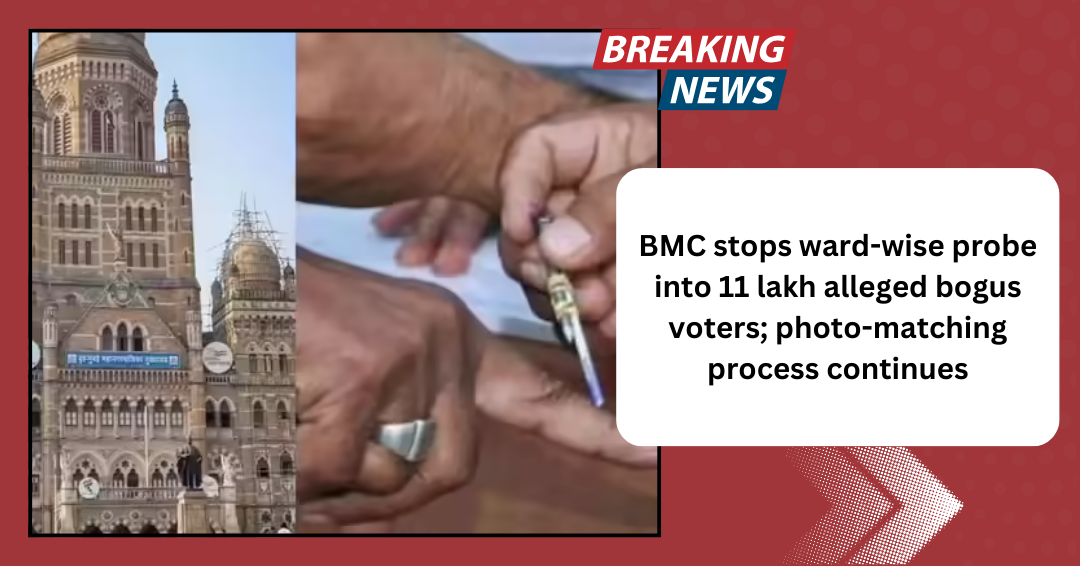
Source: Free Press Journal
The Brihanmumbai Municipal Corporation (BMC) has temporarily stopped ward-level door-to-door verification of nearly 1.1 million suspected duplicate voter entries, after encountering multiple difficulties in confirming voter identities. Until the physical verification resumes, the civic election department is carrying out photo-based internal scrutiny to prepare a final list of voters who appear more than once in the draft rolls. According to officials, field verification will restart after December 10.
The drive was initiated after the civic body received a large number of objections to the draft electoral roll. The majority of complaints pointed towards duplicate registrations, voters listed in incorrect wards or those allotted more than one polling area. Considering the scale of objections, the BMC began a ward-wise house-to-house verification to ensure accuracy in the electoral database.
However, the verification teams soon encountered serious obstacles. Many entries in the draft list had exactly the same names but different ages or addresses, making it difficult to determine whether they belonged to the same person or separate voters. Several entries were missing photographs, while some lacked other crucial personal data. Because of these inconsistencies, teams visiting homes were unable to identify voters with certainty. As a result, the civic body concluded that photo and data-matching checks at the department level are currently the most reliable and fast-track method, prompting the temporary halt in door-to-door inspections.
Additional Municipal Commissioner (City) Ashwini Joshi confirmed the decision. She stated, “Ward-level physical verification has been paused because many duplicate entries share identical names but unmatched personal details. Our election office is now verifying these records internally by checking photographs and data. House-to-house verification will resume after December 10.” She added that the Election Commission has supplied missing photographs of several suspected voters, enabling the scrutiny process to move faster.
The timeline remains extremely tight, as the final electoral roll is scheduled for publication on December 22. For example, in A Ward, authorities initially flagged 400 suspected duplicate voters, but after verification, only 18 were actually confirmed as duplicates. Such figures highlight how cautiously and meticulously the checking process needs to be executed.
On Wednesday, Joshi reviewed discrepancies, objections and pending corrections related to the draft voter list during a meeting at the BMC headquarters. She directed officers that no objection or correction request should be cleared without on-site inspection and evidence-based verification. All ward offices have also been instructed to maintain detailed tracking of complaints, supporting documents and inspection updates.
Strict administrative action has also been proposed for election staff who attempt to avoid their assigned duties. Department sources said that employees refusing to participate in electoral work will receive official notices. In addition, objections regarding deceased voters will only be entertained if the complainant furnishes documentary proof, which will then be checked against the BMC’s death records database before deleting a name from the voter list.
Meanwhile, the final polling station lists must be submitted to the central election branch by December 12, adding another crucial deadline for the civic teams working on voter database corrections. The next few days are expected to be crucial for the BMC as it must simultaneously complete photo-based internal screening, restart field inspections after December 10 and complete all corrections before the final roll is published on December 22.
In essence, the civic body is working on a two-layer verification mechanism to ensure that the upcoming municipal elections are conducted with a fully accurate voter list. The first layer involves digital scrutiny using photographs and cross-checking personal data within the election software, while the second layer involves physical door-to-door verification to validate complaints and eliminate voter fraud or duplication risks. According to senior officials, this dual approach is essential to maintain transparency and public confidence in the electoral process.
With the municipal elections approaching, the accuracy of the voter list has become a high-priority mission for the BMC. Ensuring that no eligible voter is removed and no duplicate voter entry remains in the system is crucial for conducting a free and fair civic election. Civic authorities emphasize that the large-scale verification drive—despite time pressure—is being carried out with complete seriousness, strict scrutiny and coordination between election branches and ward offices.
Image Courtesy:
Related News
This article is based on publicly available information from credible sources (as mentioned above) and has been restructured using a combination of AI tools and manual editorial inputs to enhance clarity and readability. While we aim to maintain accuracy, there may be unintentional errors or misinterpretations. If you come across any incorrect or misleading information, please report it to us at info@bmcelections.com.
Copyright © 2026 All Rights Reserved | BMC Election