BMC Elections
- Past BMC Election Results
- Know your Booth Location
- Standing Committee Members
- BMC Elections 2017 Delimitation
- New Ward List Civic Elections 2025
- New Wards Maps for BMC Elections 2025
- BMC Election 2025 Date
- CEO Maharashtra
- Know Your BMC
- BMC News & Updates
- Wards
- Candidates
- Mumbai Corporators
- Advertise
- Contact
- Volunteer
- Privacy Policy
BMC Set to Announce Final Ward Boundaries for Mumbai Civic Elections Today
- by Webdesk
- 06 Oct 2025
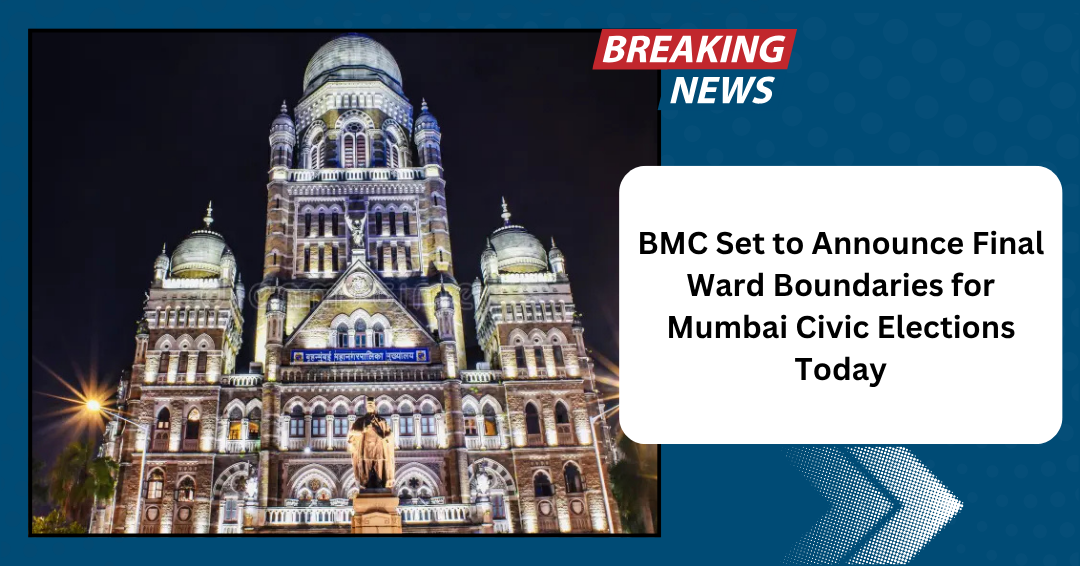
Source: The Times Of India
Mumbai: The Brihanmumbai Municipal Corporation (BMC) is all set to release the final list of ward boundaries on Monday, marking a crucial step toward the upcoming Mumbai civic elections. The move has generated significant political attention, as it sets the stage for one of the most anticipated local body polls in Maharashtra.
According to officials, the ward demarcation process has now reached its concluding stage after a series of internal reviews and public consultations. The updated boundaries have been redrawn based on the city’s changing population density and voter distribution, ensuring better administrative efficiency and fair representation.
Each BMC corporator’s ward will now consist of approximately 54,000 voters, with a minor permissible variation above or below that number. This formula has been adopted to maintain balance between various wards while keeping in mind the demographic changes across Mumbai’s diverse neighborhoods — from South Mumbai’s heritage precincts to the fast-developing suburbs in the north.
Sources from the municipal body have indicated that the new ward boundaries will be made public through an official notification. This document will outline the geographical divisions, boundaries, and updated maps for all the wards falling under the jurisdiction of the Mumbai civic body. Political parties, corporators, and citizens are expected to closely examine these details, as the new boundaries may influence political strategies and candidate selection in several key areas.
The BMC elections, which are likely to take place early next year, hold great political significance. The civic body — Asia’s richest municipal corporation — has been under an administrator’s rule since March 2022, when the term of the elected corporators officially ended on March 7, 2022. Since then, the municipal administration has been managed without an elected council for more than three years, an unusual situation for a city of Mumbai’s scale and importance.
At present, the BMC is being run by an administrator, who is also the municipal commissioner. This administrator functions under the guidance and directives of the Maharashtra state’s Urban Development Department. While routine civic operations, including infrastructure projects, health services, and sanitation, have continued as usual, several political leaders and citizen groups have raised concerns about the absence of elected representatives in the city’s local governance system.
They argue that without corporators, citizens’ grievances are not being addressed effectively at the ward level, and key decisions are being made without adequate public accountability. The upcoming polls, therefore, are being seen as a vital opportunity to restore democratic representation to the BMC.
The finalisation of ward boundaries is also expected to kickstart political campaigning in full swing. Once the ward maps are officially declared, political parties — including the Shiv Sena (in both factions), BJP, Congress, NCP, and MNS — are likely to begin candidate selection and grassroots mobilization. With the civic elections delayed for over three years, parties are expected to go all out to regain control of the prestigious civic body, which manages a massive annual budget of over ₹50,000 crore.
Historically, Mumbai’s municipal polls have played a major role in shaping Maharashtra’s political landscape. The Shiv Sena had controlled the BMC for nearly three decades before the party’s split in 2022, which led to the current division between the Shiv Sena (UBT) and the Eknath Shinde-led faction. Both groups, along with their allies, are expected to treat the forthcoming elections as a test of strength and a referendum on their political influence in Mumbai.
For the ruling Mahayuti alliance — comprising the BJP, Eknath Shinde’s Shiv Sena, and the Ajit Pawar-led NCP — the elections will be a platform to showcase their governance record and claim credit for ongoing urban development projects. On the other hand, the opposition Maha Vikas Aghadi (MVA) — led by Uddhav Thackeray’s Shiv Sena (UBT), the Congress, and Sharad Pawar’s NCP (SP) — is likely to focus on issues of public welfare, transparency, and the need to restore citizen-led governance in Mumbai.
The release of the final ward boundaries will thus not only mark the completion of a crucial administrative formality but also act as the starting signal for Mumbai’s high-stakes civic battle. Once the notification is out, the State Election Commission (SEC) is expected to finalize the election schedule in consultation with the Urban Development Department.
As Mumbai gears up for another intense political contest, civic issues like infrastructure, flooding, road maintenance, solid waste management, and housing are expected to dominate campaign agendas. The final ward demarcation will determine not just the electoral map but also the balance of power among political parties in India’s financial capital.
With the release expected today, all eyes are now on the BMC headquarters — as citizens, politicians, and administrators await the blueprint that will define the contours of Mumbai’s civic democracy for the next five years.
Image Courtesy:
Related News
This article is based on publicly available information from credible sources (as mentioned above) and has been restructured using a combination of AI tools and manual editorial inputs to enhance clarity and readability. While we aim to maintain accuracy, there may be unintentional errors or misinterpretations. If you come across any incorrect or misleading information, please report it to us at info@bmcelections.com.
Copyright © 2026 All Rights Reserved | BMC Election