BMC Elections
- Past BMC Election Results
- Know your Booth Location
- Standing Committee Members
- BMC Elections 2017 Delimitation
- New Ward List Civic Elections 2025
- New Wards Maps for BMC Elections 2025
- BMC Election 2025 Date
- CEO Maharashtra
- Know Your BMC
- BMC News & Updates
- Wards
- Candidates
- Mumbai Corporators
- Advertise
- Contact
- Volunteer
- Privacy Policy
BMC’s festive bill revealed: Over ₹246 crore spent on Ganeshotsav arrangements since 2007
- by Webdesk
- 02 Sep 2025
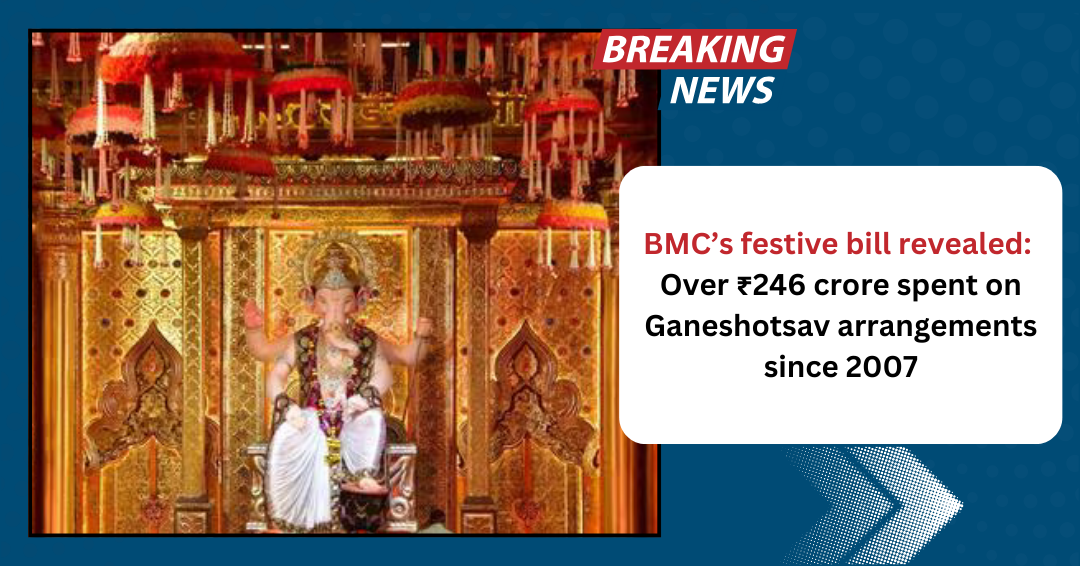
Source: Hindustan Times
Mumbai: BMC’s Ganeshotsav Expenditure Crosses ₹246 Crore in 18 Years, RTI Data Reveals
On the fifth day of this year’s Ganesh festival, more than 36,000 idols had already been immersed across Mumbai. Interestingly, only a very small portion—about 135 idols—found their way into natural water bodies. The rest were taken to artificial ponds set up by the civic body. This shift is the direct outcome of the Maharashtra Pollution Control Board (MPCB) guidelines, Bombay High Court directives, and the BMC’s aggressive push towards eco-friendly visarjans.
While this transition has certainly reduced the environmental burden on rivers, lakes, and the sea, it has also caused the civic body’s expenditure on Ganeshotsav arrangements to soar sharply over the years.
A rising expenditure curve
As per data obtained through an RTI filed by activist and lawyer Godfrey Pimenta, the BMC’s spending on Ganesh festival management was just ₹0.32 crore in 2007-08. Fast forward to 2024-25, and the figure has jumped astronomically to ₹54.47 crore.
The RTI data shows that the steepest hikes occurred during two key periods:
Between 2019-20 and 2020-21, when the onset of the Covid-19 pandemic saw expenditure rise from ₹10.2 crore to ₹22.88 crore—a staggering 124% increase.
Again, from 2022-23 to 2023-24, the cost jumped from ₹31.12 crore to ₹49.10 crore, marking another 57% rise within a single year.
In total, over the 18 years from 2007-08 to 2024-25, the civic body has spent an extraordinary ₹246.88 crore solely on Ganesh festival-related arrangements. Importantly, the final expenditure figures for the current year (2024-25) are still being compiled, meaning the total could rise further.
Activists raise red flags
Speaking about the data, Godfrey Pimenta expressed serious concern over the civic body’s expenditure pattern. “The BMC needs to exercise control over its spending. Expenditure has been rising continuously for the past five years. Even during the pandemic years, when no actual visarjans were held in large numbers, the expenditure remained disproportionately high,” Pimenta remarked.
BMC defends the spending
However, civic officials argue that the rising costs are justified in light of the growing number of artificial ponds and eco-friendly measures being introduced.
Prashant Sapkale, Deputy Municipal Commissioner of Zone 2, who oversees central Ganesh festival arrangements, explained:
“During the pandemic, public gatherings for visarjans were restricted. To ensure devotees could immerse their idols without crowding natural water bodies, the BMC constructed a larger number of makeshift artificial ponds closer to residential areas. Over the years, the civic body has expanded this figure to 288 artificial ponds across the city.”
Eco-friendly shift behind the cost rise
Environmental activists confirm that the steep rise in expenditure is linked to eco-friendly reforms. Stalin D, director of Vanashakti, said that the mandatory immersion of POP idols in artificial water bodies was introduced in 2021, following Central Pollution Control Board (CPCB) guidelines issued in 2020.
However, the BMC’s journey with artificial ponds began much earlier, in 2006, when the first few temporary tanks were introduced. As the years went by, the civic body invested heavily in scaling up the system citywide, directly contributing to higher costs.
This year, in addition to artificial ponds, the BMC has started free distribution of shadu clay to idol makers and households. The move is aimed at encouraging eco-friendly idols and reducing reliance on Plaster of Paris (POP), which is harmful to aquatic ecosystems.
In 2024-25, the initiative was taken one step further with the addition of eco-friendly paints to the distribution list, making the idols not only biodegradable but also safer for the environment when immersed.
The larger picture
While ₹246.88 crore spent in 18 years may seem like a heavy burden on the civic budget, officials argue that the investment has helped Mumbai transition towards a greener and safer Ganesh festival. Artificial ponds have drastically reduced the pollution of natural water bodies, while innovations such as eco-friendly materials and decentralised visarjan facilities have improved public safety during one of the city’s largest festivals.
Still, as activists warn, keeping expenditure in check while maintaining eco-friendly traditions will remain one of the biggest challenges for BMC in the years to come.
Image Courtesy:
Related News
This article is based on publicly available information from credible sources (as mentioned above) and has been restructured using a combination of AI tools and manual editorial inputs to enhance clarity and readability. While we aim to maintain accuracy, there may be unintentional errors or misinterpretations. If you come across any incorrect or misleading information, please report it to us at info@bmcelections.com.
Copyright © 2026 All Rights Reserved | BMC Election