BMC Elections
- Past BMC Election Results
- Know your Booth Location
- Standing Committee Members
- BMC Elections 2017 Delimitation
- New Ward List Civic Elections 2025
- New Wards Maps for BMC Elections 2025
- BMC Election 2025 Date
- CEO Maharashtra
- Know Your BMC
- BMC News & Updates
- Wards
- Candidates
- Mumbai Corporators
- Advertise
- Contact
- Volunteer
- Privacy Policy
BMC polls on hold: How Mumbai’s civic body functioned for four years without a mayor
- by Webdesk
- 22 Dec 2025

Source: India Today
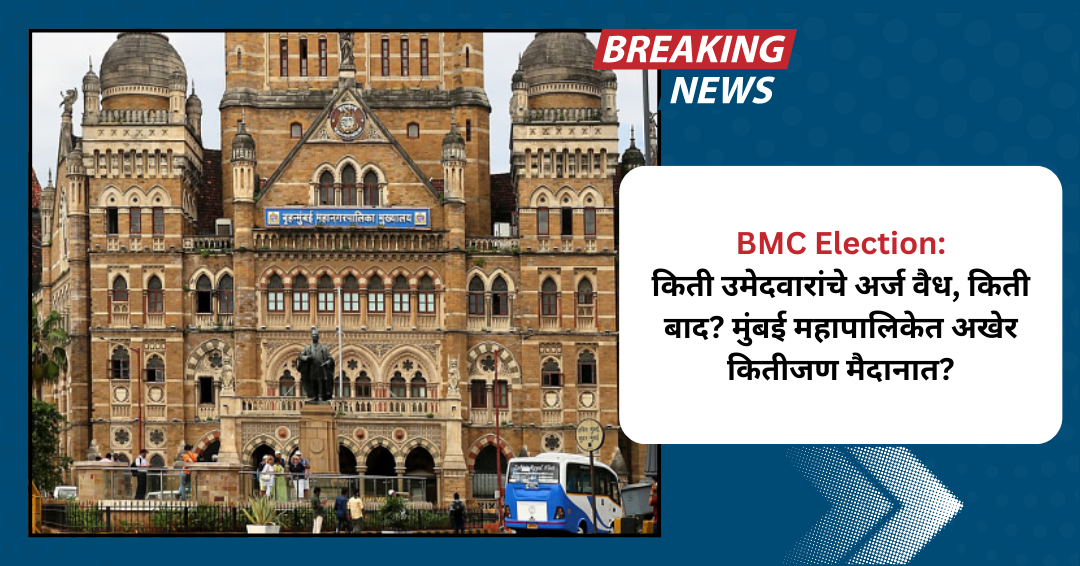
Mumbai, widely known as the City of Dreams, has never been free of challenges. However, one unprecedented situation has marked its recent civic history — the Brihanmumbai Municipal Corporation (BMC) functioning without an elected Mayor for nearly four years. This has never happened before in the city’s long municipal legacy. After repeated delays, the Maharashtra government finally announced the dates for the BMC elections last week, along with polls for 28 other municipal corporations across the state. The civic elections in Mumbai had been overdue since 2022.
Interestingly, while international events grabbed public attention, Mumbai’s local democratic vacuum went largely unnoticed. When Zohran Mamdani was elected Mayor of New York — a city that shares a sister-city relationship with Mumbai — social media and public discourse in India were flooded with discussions. It mirrored the viral “Bhupinder Jogi moment,” where a man confidently spoke about America without ever having visited it, while remaining oblivious to pressing domestic issues. In a similar vein, people debated New York’s mayoral politics, but few paused to ask an important question: who has been the Mayor of India’s financial capital? The truth is, Mumbai last elected a Mayor in 2017. That election took place almost a decade ago. Since then, the city has continued to function, but without its ceremonial head.
It is important to understand the role of Mumbai’s Mayor. Unlike cities such as Delhi, the Mayor of Mumbai does not possess executive authority. Responsibilities such as daily administration, budget planning, policy execution, contract approvals, and staff management fall under the jurisdiction of the Municipal Commissioner. This officer is an IAS appointee selected by the Maharashtra government and serves as the administrative head of the BMC. Over the past few years, officials like Iqbal Singh Chahal and later Bhushan Gagrani have overseen civic operations.
Despite the limited executive powers, the Mayor holds symbolic and democratic significance as the city’s First Citizen. The Mayor presides over meetings of the BMC’s General Body and represents the civic voice of Mumbai. This position has remained vacant since March 2022, when the term of former Mayor Kishori Pednekar ended. Since then, both Mumbai and Maharashtra have undergone significant political and administrative changes.
Understanding why the BMC elections were delayed for so long requires navigating Maharashtra’s complex political terrain — a landscape known for rapid shifts and unexpected realignments. While the BMC may appear to be just another municipal corporation, it wields enormous influence in state politics. The Shiv Sena has dominated the civic body since 1985, except for a brief period between 1992 and 1996 when the Congress held power.
One of the primary reasons for the delay was the prolonged dispute over increasing the number of BMC wards from 227 to 236. This issue remained stuck in legal proceedings for years. Alongside this, there was also the matter of implementing a 27 percent reservation for Other Backward Classes (OBCs), similar to the quota applied in Assembly elections.
The proposal to expand the number of wards was introduced in November 2021 by the Maha Vikas Aghadi (MVA) government, led by Uddhav Thackeray’s undivided Shiv Sena. Under this plan, three additional wards were proposed each for the Island City, the western suburbs, and the eastern suburbs. The MVA government argued that the increase was necessary to reflect population growth since the 2011 Census. According to their estimates, Mumbai’s population within the BMC limits had grown by nearly 3.87 percent, adding around 1.5 lakh voters. The government maintained that expanding wards would ensure fairer and more balanced representation.
However, opposition parties, particularly the BJP, strongly objected to the move. They alleged that the Shiv Sena had political intentions behind the proposal, claiming that redrawing ward boundaries could be used to benefit the ruling alliance electorally. When the Mahayuti government came to power later, it rolled back the decision and restored the number of wards to 227, citing the lack of an updated census as the primary reason.
This reversal was subsequently challenged in the Bombay High Court. However, the court upheld the Mahayuti government’s decision, ruling that reverting to 227 wards was legally valid. With the legal hurdles now cleared and election dates finally announced, Mumbai is set to return to an elected civic leadership structure. The upcoming BMC elections are expected to be closely watched, given the city’s political significance and the long administrative vacuum at the top. For India’s largest financial hub, the return of an elected Mayor will mark the end of a rare and prolonged chapter in its civic governance.
Image Courtesy:
Related News
This article is based on publicly available information from credible sources (as mentioned above) and has been restructured using a combination of AI tools and manual editorial inputs to enhance clarity and readability. While we aim to maintain accuracy, there may be unintentional errors or misinterpretations. If you come across any incorrect or misleading information, please report it to us at info@bmcelections.com.
Copyright © 2026 All Rights Reserved | BMC Election