BMC Elections
- Past BMC Election Results
- Know your Booth Location
- Standing Committee Members
- BMC Elections 2017 Delimitation
- New Ward List Civic Elections 2025
- New Wards Maps for BMC Elections 2025
- BMC Election 2025 Date
- CEO Maharashtra
- Know Your BMC
- BMC News & Updates
- Wards
- Candidates
- Mumbai Corporators
- Advertise
- Contact
- Volunteer
- Privacy Policy
BMC Issues Demolition Notice for Peru Compound’s Temporary Sheds at Lalbaugcha Raja
- by Webdesk
- 29 Aug 2025
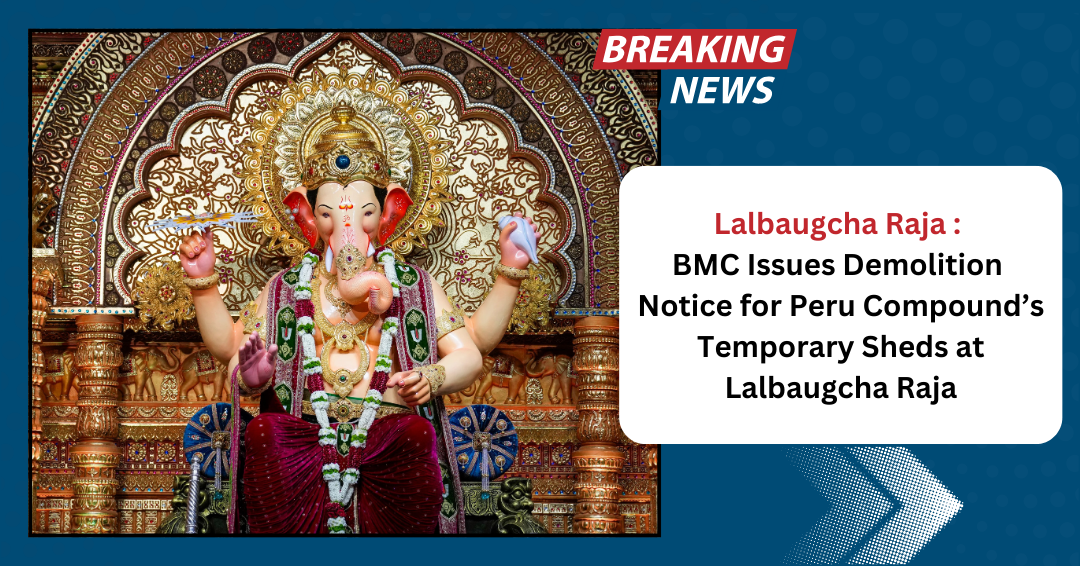
Source: Hindustan Times
BMC Action on Peru Compound Sheds at Lalbaugcha Raja
Mumbai: The Brihanmumbai Municipal Corporation (BMC) has once again come into the spotlight, this time for its action at Lalbaugcha Raja in Peru Compound. On Tuesday, civic officials pasted an official notice on the premises, directing the dismantling of three temporary sheds that had been erected without proper authorization. These sheds were meant to provide free food to devotees visiting the iconic Ganapati pandal. However, even by Thursday evening, the structures remained intact and the promised free food service had not commenced.
According to the notice issued by BMC, the organisers of the pandal were asked to immediately present valid permissions or approvals that would allow them to construct such temporary sheds. The communication further clarified that if such permissions were not furnished, the civic body would proceed with demolition within 24 hours of the notice being served. This strict warning underlined the BMC’s firm stand on unauthorized constructions, particularly during large public gatherings like the Ganesh festival.
Behind this notice lies the larger concern of public safety. Sources close to the matter, who requested not to be identified, revealed that the civic authorities were deeply worried about the possibility of overcrowding and chaos near the sheds. The narrow road leading up to the sheds has been flagged as a serious risk factor, as the congregation of thousands of devotees in such tight spaces can easily spiral into stampedes. Given the immense popularity of Lalbaugcha Raja, which draws lakhs of visitors each year, even small mismanagement could lead to tragic outcomes.
The BMC’s intervention, therefore, is not just about paperwork or permissions—it is also about averting potential disasters. The civic body has repeatedly stressed that temporary constructions for large festivals must strictly adhere to safety norms, including fire safety, crowd management, and structural stability. In this case, the lack of approvals made the situation even more precarious.
Local residents and devotees, however, expressed mixed reactions to the BMC’s step. While many agreed that safety should remain the top priority, others felt that arrangements for free food—a tradition associated with devotion and service during Ganesh Chaturthi—should not have been curtailed. Some locals argued that the sheds were put up to help devotees who stand in long queues for hours to seek darshan, and providing them with free meals is an act of faith and community spirit. On the other hand, safety experts and urban planners supported the BMC, pointing out that unplanned structures in overcrowded areas can become death traps in emergencies.
This is not the first time the civic body has locked horns with organisers over temporary constructions at major religious or cultural events. Every year during Ganesh Utsav, issues of permissions, safety clearances, and crowd management surface. In recent years, the BMC has been especially vigilant after several instances of fire hazards and overcrowding incidents at pandals across Mumbai.
At Lalbaugcha Raja, which is considered the most prominent Ganapati pandal in the city, such controversies tend to attract wider public attention. The Peru Compound notice has already sparked conversations in local political and social circles. Some believe that the civic administration is being unnecessarily strict during a festival that holds deep cultural and spiritual importance for Mumbaikars. Others feel that these measures are essential, especially in a city like Mumbai where crowd-related accidents have historically led to loss of life
The organisers of the Lalbaugcha Raja pandal have so far not made any official comment about whether they plan to furnish the required permissions or remove the sheds voluntarily. With the BMC warning still hanging over them, the next few days are likely to determine whether the structures are dismantled peacefully or the civic body steps in with force.
In the meantime, the free food distribution that was planned at these sheds has been put on hold, leaving many devotees uncertain about whether this service will resume during the festival. The episode has, however, brought to the forefront the constant tension between tradition and modern governance. On one hand, Mumbai’s festivals are symbols of unity, culture, and devotion. On the other, they also pose massive logistical challenges that require strict civic oversight.
The Peru Compound sheds issue is a reminder of how fragile the balance between faith and safety can be in a megacity like Mumbai. With millions pouring in to seek blessings of Lalbaugcha Raja, even minor lapses can lead to major consequences. The BMC, by issuing this notice, has attempted to ensure that religious fervor does not come at the cost of public safety.
As the Ganesh festival continues, all eyes remain on whether the organisers comply with the order or if this turns into yet another prolonged battle between civic rules and traditional practices. One thing is certain—when it comes to Mumbai’s festivals, the debate between devotion and discipline is unlikely to end anytime soon.
Image Courtesy:
Related News
This article is based on publicly available information from credible sources (as mentioned above) and has been restructured using a combination of AI tools and manual editorial inputs to enhance clarity and readability. While we aim to maintain accuracy, there may be unintentional errors or misinterpretations. If you come across any incorrect or misleading information, please report it to us at info@bmcelections.com.
Copyright © 2026 All Rights Reserved | BMC Election