BMC Elections
- Past BMC Election Results
- Know your Booth Location
- Standing Committee Members
- BMC Elections 2017 Delimitation
- New Ward List Civic Elections 2025
- New Wards Maps for BMC Elections 2025
- BMC Election 2025 Date
- CEO Maharashtra
- Know Your BMC
- BMC News & Updates
- Wards
- Candidates
- Mumbai Corporators
- Advertise
- Contact
- Volunteer
- Privacy Policy
BMC Elections: Sena (UBT)-MNS pact — 50-50 seat sharing in Mumbai bastions, 60-40 formula elsewhere
- by Webdesk
- 21 Sep 2025
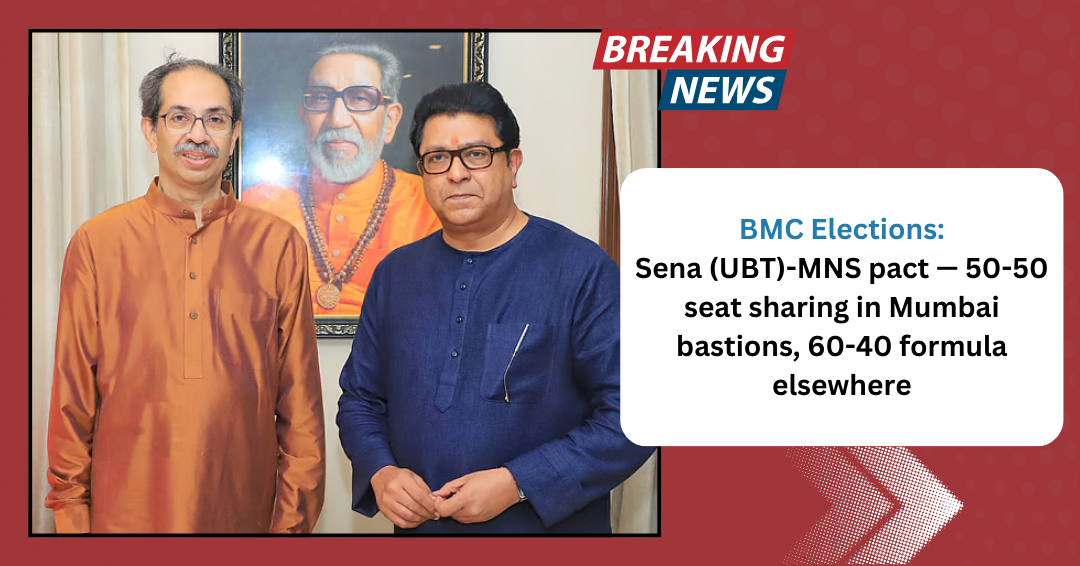
Source: The Economic Times
The political equations in Mumbai are heating up ahead of the crucial Brihanmumbai Municipal Corporation elections, as the Shiv Sena Uddhav Balasaheb Thackeray faction and the Maharashtra Navnirman Sena are close to finalizing a seat-sharing deal. According to political sources, both parties have almost reached a consensus to split seats equally in their stronghold areas, while adopting a 60:40 formula in the remaining parts of the city. Leaders from both camps have already been instructed to begin drafting ward-wise lists, indicating that the alliance is now just a formality. Sources further suggest that a formal announcement of this coalition could be made around Diwali, when the first phase of municipal elections is expected to take place.
Beyond Mumbai, the Sena (UBT) and MNS are also planning to align in key regions such as Thane, Nashik, and Kalyan-Dombivli, where both parties hold sizeable influence. The final seat distribution in these areas will be decided on the basis of each party’s local strength. The Supreme Court has also set a strict timeline, directing the Maharashtra State Election Commission to ensure that all pending civic elections across the state, including the BMC polls stalled since 2022, must be completed by January 31, 2026.
With a massive budget of over seventy-four thousand crore rupees for the year 2025-26, the BMC is considered the richest civic body in the country. Control over Mumbai’s 227 wards is seen as a political jackpot, making the upcoming election one of the most intense battles since last year’s Maharashtra assembly polls. The most contentious negotiations are centered around wards where both Sena (UBT) and MNS have a firm presence. Areas such as Dadar-Mahim, Lalbaug-Parel-Sewree, Vikhroli, Dindoshi, Ghatkopar West, Dahisar, and Bhandup fall into this category. Here, both parties have historically enjoyed Marathi-speaking voter support, and thus the plan is to share these seats equally. In neighborhoods where both parties command respect, the seat distribution will be 50-50, but in other regions, the ratio will be 60-40, with Sena (UBT) contesting more wards.
Despite the broad agreement, there are special provisions for Muslim-dominated wards. Sources revealed that these constituencies will predominantly be contested by Sena (UBT). For instance, in the Mahim assembly area, which includes two Muslim-majority wards, candidates from Uddhav’s party are expected to be fielded. Similar decisions apply to other zones like Byculla and parts of Jogeshwari. This arrangement could mean that out of 227 wards, Sena (UBT) might contest around 147 seats, while MNS would field candidates in 80 wards.
While Sena (UBT) continues to remain a part of the Maha Vikas Aghadi alongside Congress and NCP (Sharad Pawar faction), the MNS has made it clear that it is unwilling to collaborate with the Congress. On the other side, Congress leaders have also expressed reluctance to include Raj Thackeray’s party in the alliance framework. This signals that while the Sena (UBT) and MNS will work together for the civic polls, they are unlikely to expand the tie-up under the broader MVA umbrella.
This alliance marks a historic moment, as it is the first time in nearly twenty years that Uddhav Thackeray and Raj Thackeray, cousins who share a turbulent political history, are preparing to fight side by side. The two leaders have reportedly met multiple times in recent months to finalize their electoral roadmap. The significance of this unity becomes even clearer when one recalls the BMC’s history of political dominance. For over two decades, the undivided Shiv Sena controlled the civic body. However, following the dramatic split in 2022, the Eknath Shinde-led faction walked away with the party name and symbol, leaving Uddhav’s Sena (UBT) to regroup and rebuild.
In last year’s state assembly elections, Sena (UBT) contested ninety-five seats but won only twenty, its weakest performance in three decades. Meanwhile, the MNS failed to win a single seat, underlining the urgency for both parties to join forces if they are to reclaim relevance in Mumbai’s political arena. As the BMC elections inch closer, the seat-sharing agreement between Sena (UBT) and MNS is expected to alter the dynamics of Mumbai politics. With the BJP and Eknath Shinde’s faction preparing aggressive campaigns, the Thackeray cousins’ partnership will face its first major electoral test. The big question remains whether this alliance will prove to be a game changer or if it will fall short against the combined might of their rivals.
Image Courtesy:
Related News
This article is based on publicly available information from credible sources (as mentioned above) and has been restructured using a combination of AI tools and manual editorial inputs to enhance clarity and readability. While we aim to maintain accuracy, there may be unintentional errors or misinterpretations. If you come across any incorrect or misleading information, please report it to us at info@bmcelections.com.
Copyright © 2026 All Rights Reserved | BMC Election