BMC Elections
- Past BMC Election Results
- Know your Booth Location
- Standing Committee Members
- BMC Elections 2017 Delimitation
- New Ward List Civic Elections 2025
- New Wards Maps for BMC Elections 2025
- BMC Election 2025 Date
- CEO Maharashtra
- Know Your BMC
- BMC News & Updates
- Wards
- Candidates
- Mumbai Corporators
- Advertise
- Contact
- Volunteer
- Privacy Policy
BMC Elections: Political Heavyweights Lose Ground as BMC Ward Reservation Reshuffles Turf
- by Webdesk
- 12 Nov 2025
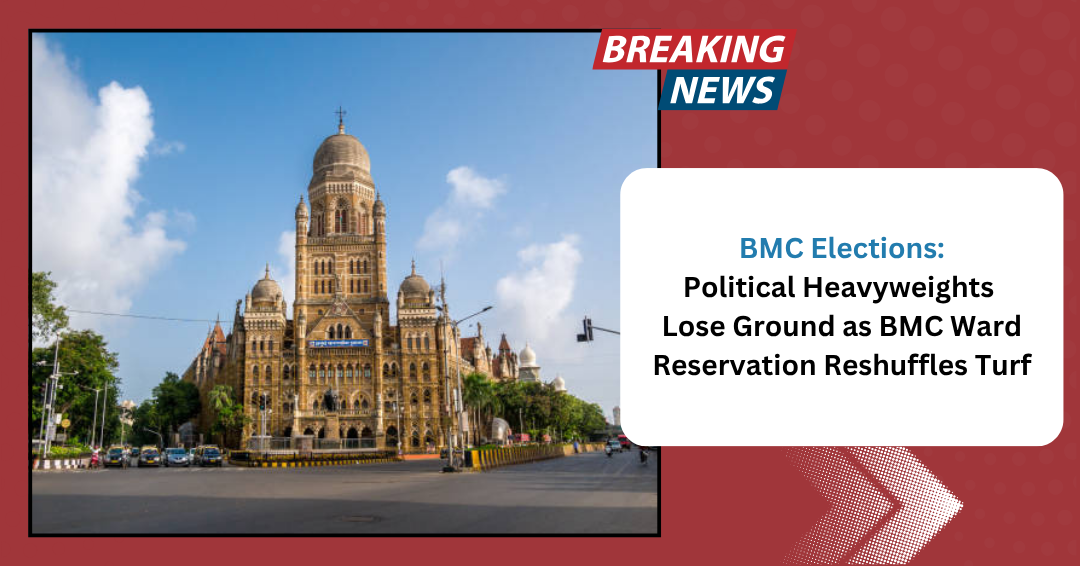
Source: The Times Of India
MUMBAI: Mumbai’s civic political scene underwent a major shake-up on Tuesday as the Brihanmumbai Municipal Corporation (BMC) conducted its much-awaited reservation lottery for all 227 electoral wards. The exercise, which determines which seats are reserved for women, Scheduled Castes (SC), Scheduled Tribes (ST), and Other Backward Classes (OBC), has left several prominent leaders without their traditional bastions, while a few narrowly managed to retain theirs.
The lottery, held at the Bal Gandharva Rangmandir in Bandra (West), was a high-stakes affair that drew political heavyweights, party workers, and media in large numbers. The atmosphere in the hall was charged with anticipation as students from a municipal school in Khar were called upon to draw chits from a transparent drum, deciding the political fate of dozens of sitting corporators.
For some, the draw brought unexpected setbacks; for others, relief. Congressman-turned-BJP leader Ravi Raja (Sion), Congress’s Asif Zakaria (Bandra), BJP’s Neil Somaiya (Mulund), Shiv Sena (UBT)’s Tejaswee Ghosalkar (Dahisar), and BJP’s Harshita Narwekar were among the well-known figures who found their home wards reserved for categories that ruled them out of contesting.
Under the new quota system, 50% of all BMC seats — 114 out of 227 — have been reserved for women. The remaining wards were categorized for OBCs, SCs, STs, and general candidates as per the lottery outcome. While some of these changes were anticipated, the actual draw reshuffled several key political areas in ways that caught parties off guard.
A number of politicians, though disappointed, are already exploring ways to stay relevant. Some hinted they may field family members or trusted party workers in their place, while others are eyeing adjacent wards that remain open.
A few leaders were lucky enough to have escaped unscathed. BJP’s Vinod Mishra managed to retain his open-category seat, while former mayor Kishori Pednekar saw her ward reserved for women once again, paving the way for her to recontest comfortably. Similarly, BJP’s Rohan Rathod and Shiv Sena’s Amey Ghole continue to hold on to their open-category wards — a significant advantage as most others scramble to realign their political strategies.
Outside the venue, the tension was palpable. Party supporters gathered around large screens set up near the auditorium, watching the proceedings live as officials rotated the transparent drum from which students picked the deciding chits. Inside, anxious murmurs filled the hall every time a ward number was announced.
Before the lottery began, municipal commissioner Bhushan Gagrani addressed the gathering, emphasizing that the entire process was being conducted transparently and strictly in accordance with the State Election Commission’s directives.
The announcement of reservations has effectively redrawn the city’s political map. Several wards that were previously considered “safe” for sitting corporators are now reserved under different categories, forcing even seasoned politicians to rethink their plans.
Political analyst Hitesh Jain compared the lottery’s effects to “a game of chess,” remarking, “This system moves politicians around like pawns on a chessboard. Instead of empowering grassroots leaders, it disrupts their connection with their constituencies. Many may lose motivation to work consistently for their voters if they know they could be shifted out of their area in the next cycle.”
The comment reflects a growing concern among parties that frequent changes in ward reservations discourage long-term leadership development. Leaders who have spent years nurturing a local voter base are suddenly displaced, while newcomers may struggle to connect with unfamiliar areas.
However, BMC officials defended the process, stating that rotation of reservation is vital for ensuring equal opportunity across communities and gender lines. “The aim is inclusivity,” said a senior civic officer. “Every election cycle gives a chance to new faces — especially women and candidates from underrepresented groups — to participate in governance.”
The political implications of the draw are far-reaching. With civic polls expected in January 2026, parties are now scrambling to redraw their internal maps, identify winnable candidates, and realign their campaign plans. For many veterans who have lost their strongholds, this could mean contesting from unfamiliar wards or taking up advisory roles instead.
Despite the disruptions, some political observers believe the shake-up could bring a fresh wave of leadership into the city’s governance. “While many stalwarts have lost their traditional seats, this opens the door for new aspirants,” said another analyst. “It could democratize the system and reduce over-dependence on legacy leaders.”
As the dust settles, the BMC’s reservation lottery has not just allocated seats — it has rewritten Mumbai’s civic political script. With new alignments forming and power equations shifting, the coming months are set to witness an intense phase of political maneuvering ahead of what promises to be one of the city’s most unpredictable elections in recent memory.
Image Courtesy:
Related News
This article is based on publicly available information from credible sources (as mentioned above) and has been restructured using a combination of AI tools and manual editorial inputs to enhance clarity and readability. While we aim to maintain accuracy, there may be unintentional errors or misinterpretations. If you come across any incorrect or misleading information, please report it to us at info@bmcelections.com.
Copyright © 2026 All Rights Reserved | BMC Election