BMC Elections
- Past BMC Election Results
- Know your Booth Location
- Standing Committee Members
- BMC Elections 2017 Delimitation
- New Ward List Civic Elections 2025
- New Wards Maps for BMC Elections 2025
- BMC Election 2025 Date
- CEO Maharashtra
- Know Your BMC
- BMC News & Updates
- Wards
- Candidates
- Mumbai Corporators
- Advertise
- Contact
- Volunteer
- Privacy Policy
BMC Elections: Data reveals MVA can’t break Mahayuti dominance without crucial support from MNS
- by Webdesk
- 25 Nov 2025
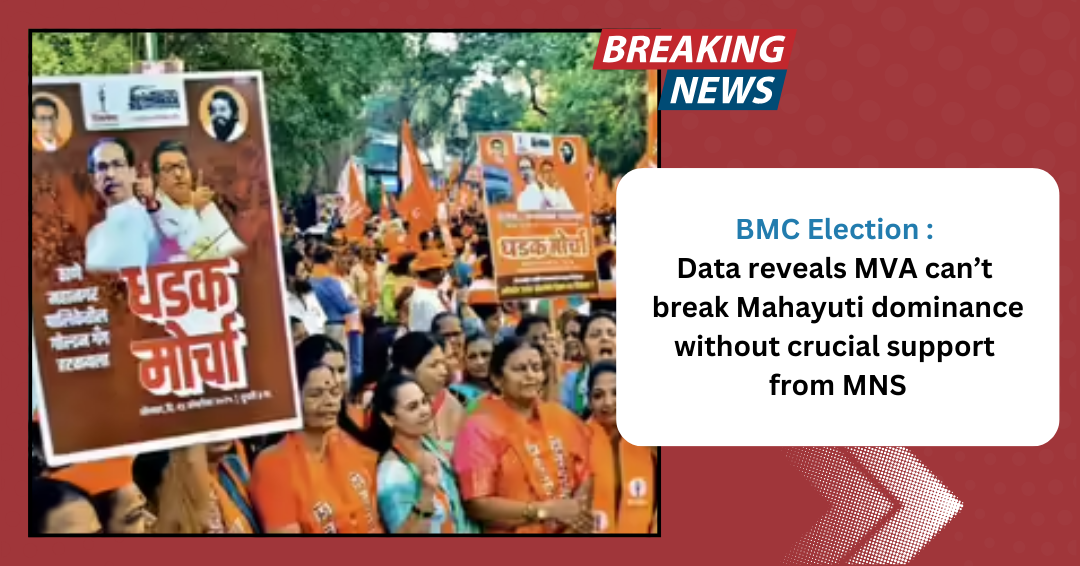
Source: The Times Of India
Mumbai: The Congress party has formally declared that it will contest the upcoming BMC elections independently and will not remain part of the Maha Vikas Aghadi (MVA) if the Maharashtra Navnirman Sena (MNS) is included in the alliance. However, a detailed ward-level assessment based on the 2024 assembly election results strongly indicates that the MVA can cross the majority figure of 114 seats in the 227-member Brihanmumbai Municipal Corporation only if MNS becomes a part of the opposition coalition.
On its own, the MVA is expected to reach only 94 corporator seats, whereas Mahayuti is projected to secure around 133 seats — giving the ruling alliance a comfortable edge. But if the MNS joins hands with the MVA — a formula that Shiv Sena (UBT) and the NCP (Sharad Pawar) seem eager to finalize — the equation changes significantly. According to wardwise mapping of assembly votes compiled by political parties using Election Commission data, a combined MVA–MNS front would have led in 116 wards, while Mahayuti’s tally would have dropped to 111, falling short of the majority mark.
Analysts point out that if the MVA disintegrates and Congress goes solo, minority votes are likely to get fragmented, which may indirectly weaken both Shiv Sena (UBT) and the NCP (SP). This could give the ruling Mahayuti additional advantage in multiple key wards.
Assembly polling data also highlights the vote influence of the MNS. In 22 wards, the number of votes polled by MNS was higher than the winning margin of Mahayuti, meaning that in a triangular contest, the presence of MNS helped Mahayuti secure victory by splitting opposition votes. Additionally, in six wards, the difference between Mahayuti and MVA was below 500 votes, making MNS a decisive factor in close battles.
Election data analyst Hitesh Jain explained the strategic importance of the party. He noted that although MNS secured a modest vote share of just under 4% in the assembly elections, it still retains strong pockets in several influential constituencies — including Worli, Mahim, Wadala, Bhandup, Versova, Magathane, Ghatkopar (West), Kalina, Chandivli, Anushakti Nagar, Sewri, and Dindoshi. According to Jain, in these areas, MVA needs just a little additional vote consolidation to surpass Mahayuti. “Only a united MVA–MNS front has the potential to defeat Mahayuti across Mumbai,” he said.
In the previous 2017 BMC elections, the MNS won seven seats, but six corporators later defected to Shiv Sena, leaving the party with only one representative in the civic body. For the 2024 assembly polls, the MNS — which skipped the Lok Sabha elections earlier that year — attempted a comeback by contesting 25 of Mumbai’s 36 seats. Out of these, 12 candidates were fielded against Eknath Shinde’s Sena and 10 against the BJP, along with one candidate in Sewri where Mahayuti did not nominate anyone, one against RPI (A), and one versus NCP. The MNS notably avoided fielding candidates against seven prominent BJP leaders.
Although the MNS failed to win a single seat in the assembly elections, it significantly impacted the outcome by dividing the Marathi vote, particularly damaging the prospects of the Shinde-led Shiv Sena. In 10 constituencies, the votes obtained by the MNS were higher than the victory margin of Sena (UBT), including high-stakes battlegrounds such as Worli, Bandra East, and Mahim.
Jain further elaborated on the ground situation: “At present, Mahayuti enjoys an advantage in Mumbai. However, the MVA — especially Shiv Sena (UBT) — still retains a strong voter base in South Mumbai and Central Mumbai. With the BMC elections getting delayed for years, dissatisfaction among party workers and rebels is expected to affect ticket distribution. Within both alliances, seat-sharing negotiations will be extremely sensitive.”
Ultimately, he added, the BMC result will depend heavily on slim margins. Votes from parties like the MNS — which can influence 25 to 30 wards with roughly 3,000 votes each — may end up deciding the final numbers. This will also be the first BMC election after the splits in Shiv Sena and NCP, making voter consolidation more crucial than ever before.
In summary, the ward-wise data narrates a clear story: without MNS, the MVA is unlikely to reach the majority figure, whereas with MNS support, the opposition could pose a serious challenge to the ruling Mahayuti.
Image Courtesy:
Related News
This article is based on publicly available information from credible sources (as mentioned above) and has been restructured using a combination of AI tools and manual editorial inputs to enhance clarity and readability. While we aim to maintain accuracy, there may be unintentional errors or misinterpretations. If you come across any incorrect or misleading information, please report it to us at info@bmcelections.com.
Copyright © 2026 All Rights Reserved | BMC Election