BMC Elections
- Past BMC Election Results
- Know your Booth Location
- Standing Committee Members
- BMC Elections 2017 Delimitation
- New Ward List Civic Elections 2025
- New Wards Maps for BMC Elections 2025
- BMC Election 2025 Date
- CEO Maharashtra
- Know Your BMC
- BMC News & Updates
- Wards
- Candidates
- Mumbai Corporators
- Advertise
- Contact
- Volunteer
- Privacy Policy
BMC Elections: Congress to release manifesto focused on pollution control and Clean Air Action Plan
- by Webdesk
- 30 Nov 2025
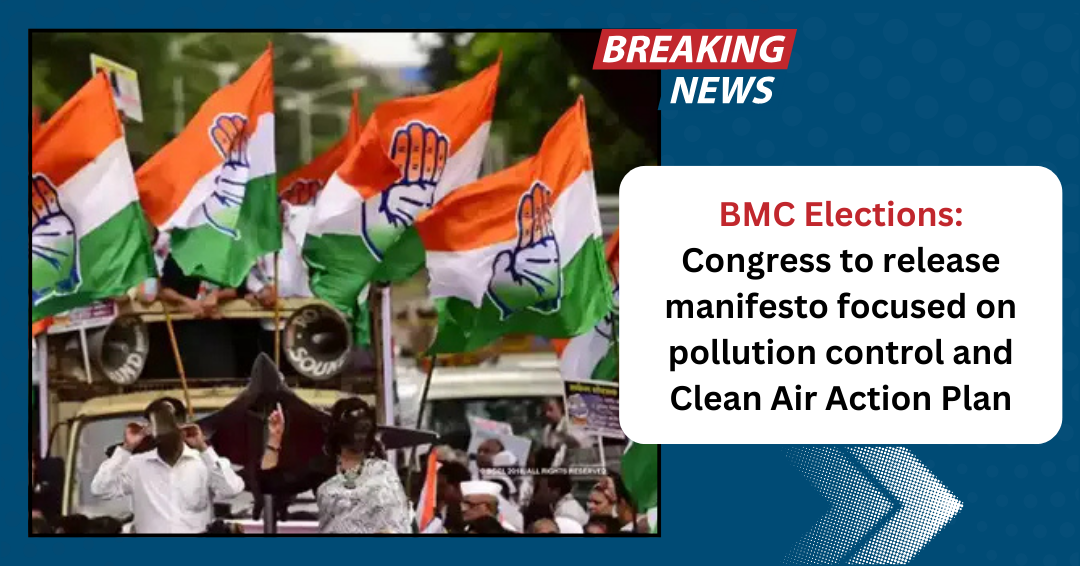
Source: Hindustan Times
Mumbai: The Mumbai Congress has strongly criticised the Mahayuti government, accusing it of prioritising real-estate interests over public welfare and neglecting the city’s escalating air pollution crisis. In an attempt to counter this, the party declared that it will unveil a Mumbai Clean Air Action Plan on Sunday, which will serve as its official manifesto for the upcoming Brihanmumbai Municipal Corporation (BMC) elections. The party claimed that the plan is entirely based on scientific research and represents its commitment to transforming Mumbai into a pollution-free metropolitan city.
Mumbai Congress President Varsha Gaikwad announced that the forthcoming manifesto will feature a data-driven strategy to improve air quality. According to her, the current state government is heavily inclined towards builder and business lobbies, and its policies are framed in a manner that repeatedly favours them. “Environmentally sensitive open spaces are being handed over to favoured real estate developers instead of being protected,” Gaikwad stated. She further alleged that the BMC has failed to create any concrete plan to curb the pollution that threatens Mumbai’s health and sustainability.
Gaikwad emphasised that Congress has closely studied independent research papers and environmental reports before drafting the new action plan. “We are not just exposing the flaws of the present administration; we are offering actionable solutions. Along with the plan, we will specify deadlines and implementation schedules for each measure so that citizens can track progress,” she added. The party intends to position itself as the only political front presenting a scientifically-validated roadmap rather than broad promises.
Mumbai Congress spokesperson Sachin Sawant also reiterated the allegations against the government and the BMC. He said that both authorities had initially assured citizens that strict action would be taken against construction projects that violate norms and contribute to dust pollution. However, Sawant pointed out that despite multiple warnings about the growing threat to public health, no substantial measures have been undertaken. “Mumbai’s air quality has deteriorated by 22%, yet not a single major step has been taken against errant builders. The Mahayuti government’s close connections with builders protect them from facing penalties,” he said.
Sawant stressed that air pollution is no longer just an environmental issue but has escalated into a severe health emergency in the city. He claimed that constant dust exposure from large-scale development activities, combined with traffic emissions, has resulted in worsening respiratory problems among residents, especially children and senior citizens. He further suggested that preventive measures could have been enforced if the administration had prioritised public health over corporate interests.
Gaikwad also cited findings from a study conducted by Harvard University, underlining the alarming human cost of pollution in Mumbai. According to the report, approximately 5,100 deaths occur every year in the city as a direct result of deteriorating air quality. She remarked that losing thousands of lives annually due to preventable causes reflects a systemic governance failure. “Air pollution must be treated as a public health disaster. Citizens deserve an administration that puts life and safety first,” she stated.
The Mumbai Clean Air Action Plan, according to Congress, is expected to outline steps such as controlling dust from construction sites, strengthening monitoring systems for air quality, increasing urban green cover, regulating industrial pollution, improving public transportation infrastructure, and introducing air-purifying initiatives in congestion-prone zones. The party claims that transparency and accountability will be integral to the plan, with clear performance metrics and periodic review mechanisms.
Congress leaders aim to shift the focus of the BMC elections toward environmental responsibility, underlining that urban development must not come at the cost of citizens’ health. With rising public concern over pollution in recent years, the party believes the new manifesto will resonate strongly with voters. The plan is also expected to highlight the need to safeguard Mumbai’s limited open spaces, wetlands, coastal belts, parks and mangroves from unchecked developmental activities.
By transforming the environmental issue into a central electoral agenda, Congress hopes to challenge the ruling government’s image and project itself as a party committed to sustainable development instead of profit-driven city planning. The party’s leadership argues that any government that fails to protect its citizens from life-threatening pollution forfeits its right to lead the financial capital.
The unveiling of the Mumbai Clean Air Action Plan is likely to intensify the political battle ahead of the BMC polls, with environmental safety emerging as a major voter concern. For Congress, the plan represents not only an electoral promise but also a declaration of change — an assurance that the city’s future will not be compromised under political or corporate pressure.
Image Courtesy:
Related News
This article is based on publicly available information from credible sources (as mentioned above) and has been restructured using a combination of AI tools and manual editorial inputs to enhance clarity and readability. While we aim to maintain accuracy, there may be unintentional errors or misinterpretations. If you come across any incorrect or misleading information, please report it to us at info@bmcelections.com.
Copyright © 2026 All Rights Reserved | BMC Election