BMC Elections
- Past BMC Election Results
- Know your Booth Location
- Standing Committee Members
- BMC Elections 2017 Delimitation
- New Ward List Civic Elections 2025
- New Wards Maps for BMC Elections 2025
- BMC Election 2025 Date
- CEO Maharashtra
- Know Your BMC
- BMC News & Updates
- Wards
- Candidates
- Mumbai Corporators
- Advertise
- Contact
- Volunteer
- Privacy Policy
BMC Elections 2025: Congress sets sights on an independent fight, prepares to contest without alliances
- by Webdesk
- 13 Sep 2025
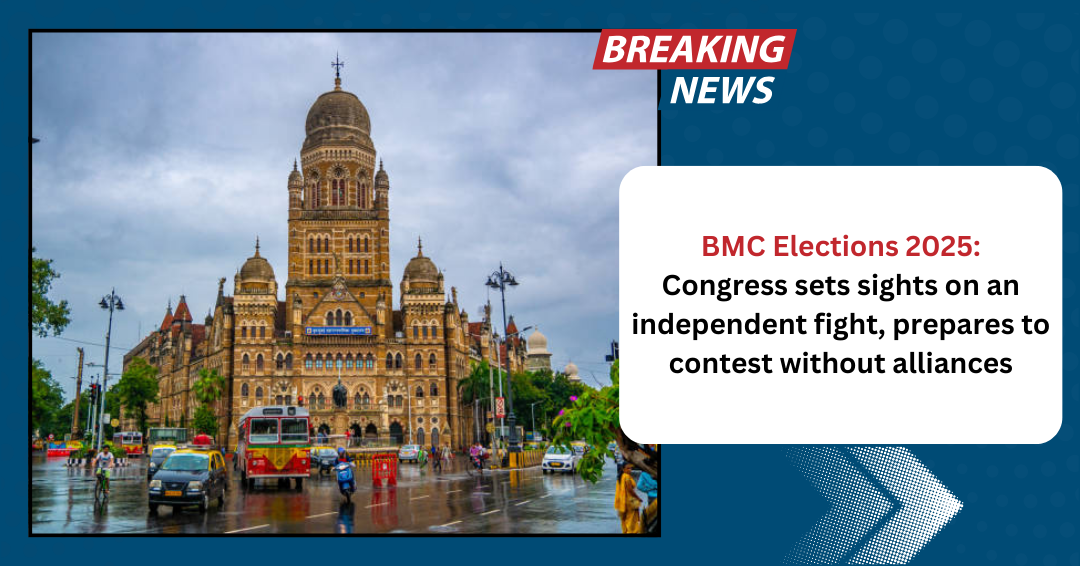
Source: Hindustan Times
Mumbai: With growing signs that the Thackeray cousins—Uddhav Thackeray of Shiv Sena (UBT) and Raj Thackeray of Maharashtra Navnirman Sena (MNS)—may maintain a distance from the Maharashtra Vikas Aghadi (MVA) alliance in the forthcoming civic polls, the Mumbai Congress has shifted its focus to preparing for a solo fight in the upcoming Brihanmumbai Municipal Corporation (BMC) elections.
The party took its first strong step on Friday by unveiling a campaign titled “Mahayuti Sarkar Mast, Mumbaikar Trast”. Through this slogan, Congress is attempting to capture public attention by alleging that the ruling coalition and the Bharatiya Janata Party (BJP) are enjoying power while ordinary Mumbaikars continue to suffer under rampant corruption and mismanagement in the city’s civic body.
Mumbai Congress chief Varsha Gaikwad spearheaded the campaign launch with scathing allegations against the BJP-led administration. She claimed that the BJP and its allies had turned the BMC into a hub of corruption where public funds were being systematically looted. According to her, rules and tender conditions are being manipulated and tailored to ensure that only a select few contractors—those considered close to the ruling establishment—are able to bag major projects. Gaikwad went a step further, accusing the state’s Urban Development Department of being reduced to what she termed an “Urban Disaster Department” because of its inability to serve citizens effectively.
Adding further details, Congress spokesperson Sachin Sawant stated that the central theme of the campaign will be to expose case after case of corruption, irregularities, and financial mismanagement in Mumbai’s civic projects. He pointed out that the upcoming BMC polls will be fought not just on governance issues but also on the larger question of accountability and transparency in how taxpayers’ money is spent.
Sawant highlighted a specific instance to underline Congress’s allegations. He referred to a pipeline project tender that was initially floated for a 42-kilometre stretch from the Tunnel Shaft at Gundavali to Wye Junction at Modaksagar. Later, this project length was mysteriously extended to 50 kilometres. The terms and conditions of this tender, Sawant claimed, were framed in such a way that only two contractor companies associated with the BMC could realistically qualify for the contract.
According to him, one of the most questionable conditions was that the pipe fabrication unit had to be located within a 150-km radius of the project site. This stipulation, Sawant alleged, was deliberately inserted to ensure that only two pipe-manufacturing companies—Vishal Enterprises and Samruddhi—could participate, since they were the only ones meeting the criterion. Effectively, whichever construction contractor had signed an MoU with these two companies would automatically be favoured to secure the multi-crore project.
Sawant reminded that this was not the first time such restrictive conditions had been used to favour select contractors. He recalled that in the past too, a controversial civic project had been awarded under similar terms to APCO, a contractor firm that also had MoUs with the same two pipe-manufacturing companies. This pattern, he argued, clearly exposes how tenders are designed not with public interest in mind but to benefit a handful of pre-determined players.
The Congress leadership insists that the only criteria that should matter in such civic projects are timely completion and quality of work. Instead, they argue, the BJP-led administration has reduced the process to a nexus where rules are manipulated, contractors are handpicked, and citizens are ultimately left to suffer the consequences of poor planning and substandard infrastructure.
By choosing to highlight such cases, the Mumbai Congress is aiming to send a direct message to citizens—that the city’s largest civic body has been hijacked by vested interests and that the time has come for a change. Political observers note that this campaign marks a significant shift in Congress’s strategy. Rather than waiting for clarity on alliances, the party has chosen to go on the offensive, building its own narrative for the elections and positioning itself as the voice of “Mumbaikars betrayed by corruption.”
The backdrop of this campaign is crucial. The BMC elections are among the most high-stakes political battles in Maharashtra, not just because of the sheer size of the civic body’s annual budget—which runs into thousands of crores—but also because of its symbolic value in Mumbai’s political landscape. For decades, the Shiv Sena, in its undivided form, dominated the BMC. But with the party split and alliances shifting, Congress sees an opening to re-establish its presence.
As the campaign gathers momentum, Congress leaders are expected to hold a series of press conferences, rallies, and social media drives to keep corruption cases in the spotlight. While the ruling BJP and its allies are yet to respond in detail, the “Mahayuti Sarkar Mast, Mumbaikar Trast” slogan has already begun to trend in local political discussions.
Political analysts suggest that if Congress can sustain this narrative and successfully tap into citizen anger over civic mismanagement, it could significantly boost its chances in the BMC polls—even without the backing of the MVA alliance.
Image Courtesy:
Related News
This article is based on publicly available information from credible sources (as mentioned above) and has been restructured using a combination of AI tools and manual editorial inputs to enhance clarity and readability. While we aim to maintain accuracy, there may be unintentional errors or misinterpretations. If you come across any incorrect or misleading information, please report it to us at info@bmcelections.com.
Copyright © 2026 All Rights Reserved | BMC Election