BMC Elections
- Past BMC Election Results
- Know your Booth Location
- Standing Committee Members
- BMC Elections 2017 Delimitation
- New Ward List Civic Elections 2025
- New Wards Maps for BMC Elections 2025
- BMC Election 2025 Date
- CEO Maharashtra
- Know Your BMC
- BMC News & Updates
- Wards
- Candidates
- Mumbai Corporators
- Advertise
- Contact
- Volunteer
- Privacy Policy
BMC Elections 2025: BJP set to contest 140–150 seats, likely to allocate 70–80 seats to Shinde’s Shiv Sena
- by Webdesk
- 25 Oct 2025
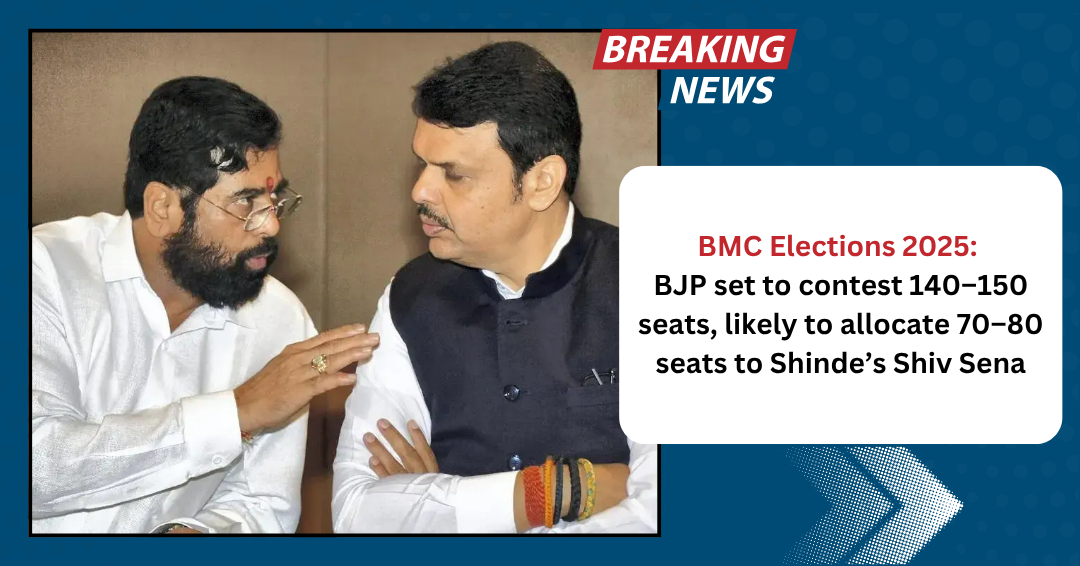
Source: India TV News
Mumbai: As the political temperature rises ahead of the Brihanmumbai Municipal Corporation (BMC) elections, the Bharatiya Janata Party (BJP) has accelerated its preparations and begun finalizing its electoral blueprint. According to party sources, the BJP plans to contest around 140 to 150 seats, while its ally, the Eknath Shinde-led Shiv Sena, is expected to field candidates in approximately 70 to 80 wards under the Mahayuti alliance framework.
Party insiders indicate that the BJP is confident about improving its performance compared to the previous elections and aims to emerge as the dominant force in Mumbai’s civic body. The strategy revolves around leveraging strong booth-level organization, direct voter engagement, and issue-based campaigning on civic infrastructure, health, sanitation, and urban development — areas where the BMC’s performance has often drawn public scrutiny.
Meanwhile, the BJP’s city unit has intensified activities at the grassroots level. Meetings are being held across wards to strengthen local committees, identify potential candidates, and enhance voter outreach. The party is also focusing on data-driven campaign management, deploying its digital teams to collect and analyze feedback from Mumbaikars through door-to-door surveys and online engagement platforms.
At the same time, Chief Minister Eknath Shinde has been holding discussions with alliance partners to ensure unity within the Mahayuti. During recent internal meetings, he reportedly urged all leaders and workers to avoid public statements that could fuel speculation or trigger internal disputes. Shinde emphasized the importance of coordination, mutual respect, and teamwork to secure a decisive victory for the alliance.According to senior political analysts, the BMC elections are not just a civic contest but a political battleground that could influence the state’s larger political equation ahead of the 2029 Maharashtra Assembly elections. For the BJP and Shinde’s Sena, a strong showing in Mumbai would reinforce their dominance in urban Maharashtra, while for the opposition Maha Vikas Aghadi (MVA) — comprising Uddhav Thackeray’s Shiv Sena (UBT), Congress, and Sharad Pawar’s NCP — it is a fight to retain their traditional strongholds.
Sources close to the BJP suggest that the party views growing internal rifts within the MVA as an opportunity. The coalition has faced ideological and organizational differences, particularly between the Shiv Sena (UBT) and the Congress over seat-sharing and local leadership. BJP strategists believe these fissures could work to their advantage, allowing the Mahayuti to expand its influence in key Marathi-dominated pockets that have historically supported the MVA.
Adding another twist to the city’s political narrative, reports have surfaced about Uddhav and Raj Thackeray exploring the possibility of a new understanding or alliance for the civic elections. If realized, this could lead to a significant Marathi manoos vote consolidation, potentially drawing support from minority groups as well.
Reacting to these developments, the BJP has decided to strengthen internal coordination within the Mahayuti instead of contesting independently. Senior BJP leaders have reportedly advised against a solo campaign, warning that a divided alliance could split the Hindutva and pro-government vote, indirectly benefiting the opposition.
During a recent Diwali gathering, a senior BJP functionary remarked that while the BJP remains the principal force in the alliance, it recognizes the importance of the Shinde Sena’s local presence in certain wards. “Unity within the Mahayuti is not just about arithmetic — it’s about consolidating trust among diverse voter groups,” the leader said.
The BJP’s core voter base, which includes upper-caste business communities, Gujaratis, and North Indian voters, remains loyal. However, party leaders acknowledge the need to strengthen Marathi voter outreach to balance the influence of the Thackeray-led parties. This has led to increased engagement with Marathi cultural groups, small business owners, and local community leaders to rebuild emotional and political connections at the ward level.
In neighboring Thane, which remains a political stronghold of Chief Minister Eknath Shinde, the alliance dynamics are expected to be guided by Shinde himself. Party insiders note that the BJP has adopted a flexible approach there, allowing local leaders greater autonomy in decision-making, especially in rural and semi-urban areas where localized issues dominate.
As the BMC polls draw closer, both alliances — Mahayuti and MVA — are gearing up for what is expected to be a high-stakes, high-voltage contest. The outcome will not only decide who controls India’s richest civic body but could also serve as a barometer for Maharashtra’s broader political sentiment ahead of the next assembly election cycle.
For now, the BJP and Shinde Sena appear determined to project a united front, emphasizing teamwork, coordination, and a common vision for Mumbai’s development — even as political observers warn that much will depend on seat-sharing clarity, candidate selection, and the ability of both parties to keep local ambitions in check.
Image Courtesy:
Related News
This article is based on publicly available information from credible sources (as mentioned above) and has been restructured using a combination of AI tools and manual editorial inputs to enhance clarity and readability. While we aim to maintain accuracy, there may be unintentional errors or misinterpretations. If you come across any incorrect or misleading information, please report it to us at info@bmcelections.com.
Copyright © 2026 All Rights Reserved | BMC Election