BMC Elections
- Past BMC Election Results
- Know your Booth Location
- Standing Committee Members
- BMC Elections 2017 Delimitation
- New Ward List Civic Elections 2025
- New Wards Maps for BMC Elections 2025
- BMC Election 2025 Date
- CEO Maharashtra
- Know Your BMC
- BMC News & Updates
- Wards
- Candidates
- Mumbai Corporators
- Advertise
- Contact
- Volunteer
- Privacy Policy
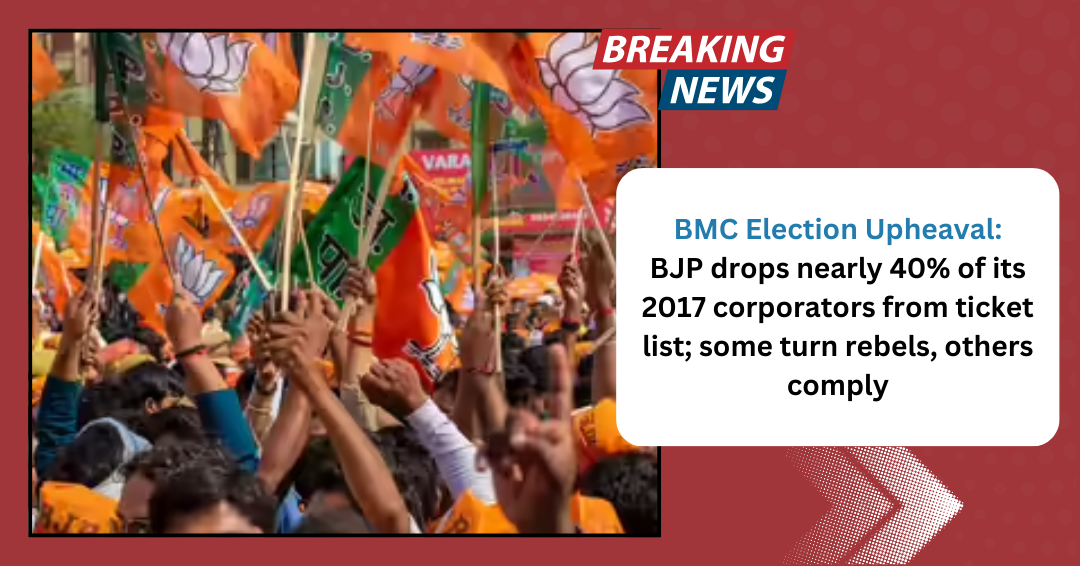
BMC Election Upheaval: BJP drops nearly 40% of its 2017 corporators from ticket list; some turn rebels, others comply
- by Webdesk
- 01 Jan 2026
Source: The Times Of India
Mumbai: Ahead of the upcoming Brihanmumbai Municipal Corporation (BMC) elections, the Bharatiya Janata Party (BJP) has taken a major and somewhat surprising decision by denying tickets to nearly 40% of its corporators who were elected in the 2017 civic polls. The move has led to mixed reactions within the party, with some leaders accepting the decision, while others have chosen to rebel or switch sides.
Several of the sitting corporators were unable to secure tickets due to changes in ward reservations, while others were dropped to make room for new entrants who recently joined the party from rival political outfits. In addition, the BJP leadership has also cited the need to promote fresh and younger faces as one of the key reasons behind this reshuffle.
In the 2017 BMC elections, the BJP had emerged as a strong force by winning 82 seats. For the forthcoming polls scheduled on January 15, the party has announced a list of 137 candidates. As part of its alliance arrangement, it has conceded 90 seats to the Shiv Sena led by Maharashtra Deputy Chief Minister Eknath Shinde.
A significant number of corporators who have not been renominated belong to the western suburbs of Mumbai. Notably, among those denied tickets are close relatives of sitting MLAs, including the wife of one legislator and the son of another. This has added to the perception that the party has taken a tough stand, even against influential political families.
Prominent names missing from the BJP’s candidate list include Jyoti Alavani, who is the wife of Vile Parle MLA Parag Alavani; Sagar Singh Thakur from Kandivli; Deepak Thakur, the son of Goregaon MLA Vidya Thakur; Nehal Shah from the Matunga–Sion belt; and Asawari Patil from Magathane. Their exclusion has drawn considerable attention within political circles.
Additionally, several other former corporators have also been left out. These include Atul Shah from South Mumbai, whose ward has now been reserved for women, as well as leaders who transitioned to higher offices in recent years. Some corporators who became MLAs last year were naturally not renominated, while others like Manoj Kotak—who served as a corporator before becoming a Member of Parliament from 2019 to 2024—were also excluded from the list.
According to party insiders, many of the leaders who were denied tickets outright come from areas traditionally considered BJP strongholds. Sources further revealed that several senior corporators were not accommodated in neighbouring wards either, a flexibility that was extended only in select cases. This has intensified dissatisfaction among some sections of party workers.
Reactions to the BJP’s decision have varied widely. While a few denied corporators have decided to contest the elections as independent candidates, others have chosen different political paths. For instance, Nehal Shah has opted to enter the fray as an independent, whereas Asawari Patil has joined the rival Shiv Sena (Uddhav Balasaheb Thackeray faction) and is contesting from her ward in Magathane.
On the other hand, several leaders have accepted the party’s decision and have chosen to continue working for BJP candidates. Atul Shah, who had famously won the previous election through a draw of lots after he and his opponent received an equal number of votes, stated that he has now thrown his support behind the party’s new candidate, Deepali Kulthe. With his ward reserved for women, Shah said he is actively helping in her campaign.
Speaking about Kulthe, Shah highlighted her grassroots connection, noting that she had worked for many years as an arogya sevika and had extensive outreach in the area, particularly through her involvement in administering polio drops. He expressed satisfaction with the party’s decision to give opportunities to such individuals, stating that he was fully supportive of the move.
Jyoti Alavani also clarified that her decision not to contest the election was personal. She stated that irrespective of whether her ward was reserved or not, she had already decided to step away from the electoral race and is now assisting the BJP’s new candidate in her area.
However, the party’s candidate selection process has not been without friction. In some localities, the decision has sparked open resentment among grassroots workers. At a party programme held in Dahisar to welcome a new entrant, Tejaswi Ghosalkar, a BJP woman worker publicly questioned the leadership. From the stage itself, she demanded an explanation from MLA Manisha Chaudhary and former MP Gopal Shetty on why a long-serving party worker like herself was denied a ticket.
Overall, the BJP’s aggressive overhaul of its candidate list has clearly reshaped the political landscape ahead of the BMC elections, triggering loyalty, rebellion, and debate within the party ranks.
Image Courtesy:
Related News
This article is based on publicly available information from credible sources (as mentioned above) and has been restructured using a combination of AI tools and manual editorial inputs to enhance clarity and readability. While we aim to maintain accuracy, there may be unintentional errors or misinterpretations. If you come across any incorrect or misleading information, please report it to us at info@bmcelections.com.
Copyright © 2026 All Rights Reserved | BMC Election