BMC Elections
- Past BMC Election Results
- Know your Booth Location
- Standing Committee Members
- BMC Elections 2017 Delimitation
- New Ward List Civic Elections 2025
- New Wards Maps for BMC Elections 2025
- BMC Election 2025 Date
- CEO Maharashtra
- Know Your BMC
- BMC News & Updates
- Wards
- Candidates
- Mumbai Corporators
- Advertise
- Contact
- Volunteer
- Privacy Policy
BMC calls for proposals to develop an exotic bird park at Nahur, promising a new destination for nature and wildlife lovers
- by Webdesk
- 30 Aug 2025
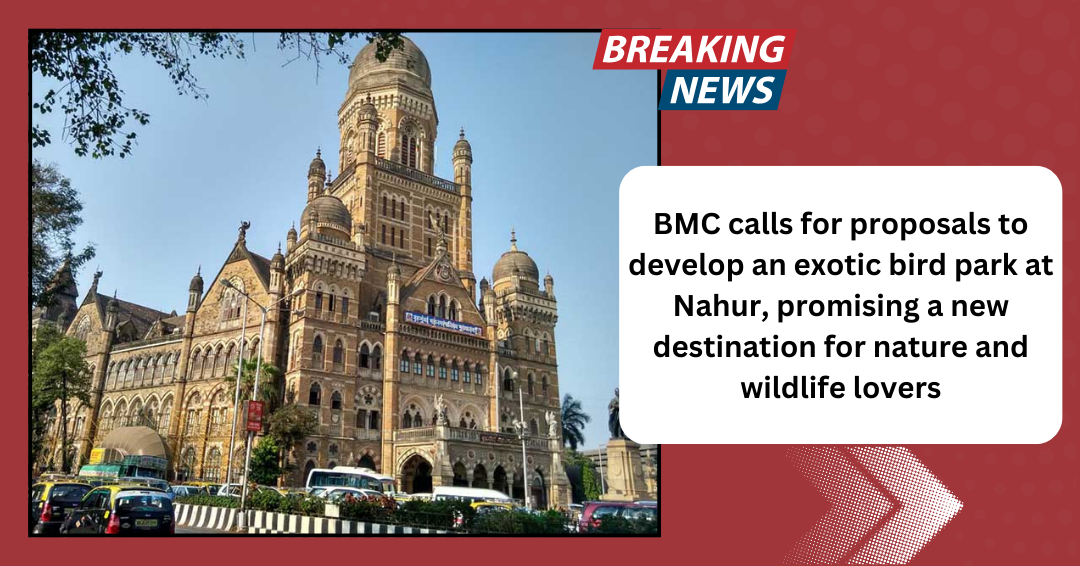
Source: The Times Of India
Mumbai: BMC Floats Tender for Exotic Bird Park at Nahur
On Friday, the Brihanmumbai Municipal Corporation (BMC) officially invited bids for the ambitious development of an Exotic Bird Park in Nahur, marking a significant step toward adding a unique eco-tourism landmark to the city. The project, which comes with a tentative block cost of ₹166 crore, will be executed under an EPC (Engineering, Procurement, and Construction) model. This means that while the conceptual design and drawings will be provided by the consultant appointed by the BMC, bidders will be required to quote their rates and execute the project based on those plans.
World-Class Aviary with Diverse Bird Species
According to the tender documents, the proposed bird park will be home to a wide variety of exotic and native species, including macaws, parrots, toucans, swans, pelicans, ostriches, peafowls, and pheasants. The enclosures are expected to be designed with stainless steel tensile wire rope mesh systems. These structures will not only ensure the safety of both visitors and birds but will also attempt to replicate natural habitats, thereby creating a more authentic environment for the birds.
The project’s design also includes well-planned supporting infrastructure such as paddock areas, landscaped gardens, artificial rock formations, serene water bodies, and aviary-inspired shelters, all of which will collectively simulate native ecosystems.
Beyond Recreation: Conservation and Research Hub
The scope of the development goes well beyond merely being a tourist attraction. The bird park is planned to function as a centre for conservation, education, and research. Facilities like veterinary hospitals, quarantine areas, and interpretation centres will be part of the project, ensuring that the health, welfare, and long-term care of the birds remain central to its operations.
To make the park engaging for visitors, the proposal also includes bird show arenas, underground parking, modern audio-visual systems for awareness programs, and eco-friendly features such as solar energy and energy-efficient lighting systems.
Advanced Infrastructure and Technology
The operations blueprint for the park specifies the inclusion of comprehensive mechanical and electrical services. These will range from substations, diesel backup generators, and UPS systems to CCTV surveillance, biometric access systems, HVAC setups, and an integrated building management system.
In addition, highly sensitive enclosures will be equipped with advanced Life Support Systems (LSS), ensuring the maintenance of waterfalls, aquariums, and other specialised habitats needed for select species.
Commitment to Sustainability
Keeping in line with Mumbai’s growing emphasis on sustainable development, the project has made sustainability a major priority. Provisions for rainwater harvesting, renewable energy systems, and efficient ventilation methods have been included. The landscaping plan envisions plantations of trees, creepers, and shrubs, in addition to bird enrichment devices designed to encourage natural behaviours among various species.
Local Leadership and Historical Context
Mulund MLA Mihir Kotecha, who has been actively pursuing this project, welcomed the move. He highlighted its significance by stating, “After more than a hundred years, Mumbai will finally have a new aviary, and that too in Mulund. The British established Mumbai’s first zoo, and now in independent India, this will be the first facility of its kind – a Bird Park. We are even exploring collaboration with Singapore’s world-famous Jurong Bird Park to help create an international-standard attraction.”
He further noted that the residents of Mumbai’s eastern suburbs, which together have a population of nearly 25 lakh, as well as people from Navi Mumbai and Thane, would greatly benefit from the project. He also emphasised that the Bird Park will not only be an eco-tourism highlight but also a major tourist destination in the region.
Historically, the last such development dates back to 1890, when 15 acres were added to the Byculla Botanical Garden, along with the introduction of animals. With this project, the BMC aims to revive that legacy by creating a new cultural and ecological landmark in the city.
Image Courtesy:
Related News
This article is based on publicly available information from credible sources (as mentioned above) and has been restructured using a combination of AI tools and manual editorial inputs to enhance clarity and readability. While we aim to maintain accuracy, there may be unintentional errors or misinterpretations. If you come across any incorrect or misleading information, please report it to us at info@bmcelections.com.
Copyright © 2026 All Rights Reserved | BMC Election