BMC Elections
- Past BMC Election Results
- Know your Booth Location
- Standing Committee Members
- BMC Elections 2017 Delimitation
- New Ward List Civic Elections 2025
- New Wards Maps for BMC Elections 2025
- BMC Election 2025 Date
- CEO Maharashtra
- Know Your BMC
- BMC News & Updates
- Wards
- Candidates
- Mumbai Corporators
- Advertise
- Contact
- Volunteer
- Privacy Policy
Ahead of Maharashtra Civic Polls, Opposition Leaders Hold Crucial Talks with Election Commission
- by Webdesk
- 14 Oct 2025
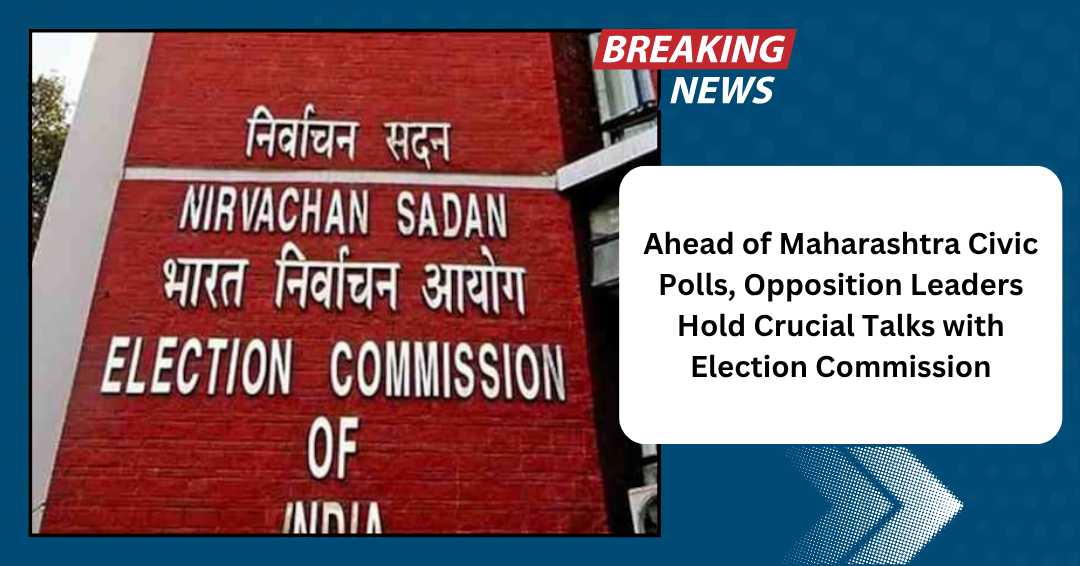
Source: NDTV
Mumbai: In a significant show of unity, senior leaders from almost all major Opposition parties in Maharashtra met State Chief Electoral Officer S. Chokalingam on Tuesday, submitting a joint memorandum seeking transparency, fairness, and accountability from the Election Commission ahead of the long-delayed local body elections.
The all-party delegation included prominent leaders such as Sharad Pawar (NCP–Sharad Pawar faction), Uddhav Thackeray (Shiv Sena–UBT), Raj Thackeray (MNS), Balasaheb Thorat (Congress), Jayant Patil (Peasants and Workers Party), Ajit Navle (CPI–Marxist), and Subhash Lande (CPI). Together, they urged the Commission to ensure free and fair elections while addressing the growing concerns over voter data and the absence of VVPAT machines.
The memorandum accused the Commission of “undermining public faith” through a lack of transparency in voter list management and its controversial decision to exclude Voter Verifiable Paper Audit Trail (VVPAT) machines from the upcoming civic polls. Referring to Bihar’s recent initiative to clean up electoral rolls, the delegation said Maharashtra must adopt similar corrective measures to restore people’s confidence in the electoral process.
“The Election Commission is expected to act as an independent body,” the joint statement read. “However, the way it is functioning today raises serious doubts about its autonomy.”
Key Issues Highlighted in the Memorandum
The Opposition’s memorandum listed six major areas of concern.The first was the non-disclosure of voter names deleted during the 2024 Lok Sabha and Assembly elections. The delegation demanded that all such deletions be made public, along with the specific reasons, arguing that every citizen has the right to know why their name was removed from the rolls.
Secondly, they questioned why the voter list revisions made between October 2024 and July 2025 have not yet been published. Opposition leaders said that withholding this information prevents political parties and citizens from verifying the lists, thereby raising suspicion of political interference or hidden motives.
A third major objection was to the Election Commission’s plan to use the voter list as of July 1, 2025 for the civic elections. According to the delegation, this would disenfranchise thousands of newly eligible voters who turn 18 after that date — effectively depriving them of their constitutional right to vote for the next five years.
The memorandum also raised concerns about double voter registrations among migrant populations, particularly those who move between Maharashtra and other states for work. The Opposition urged the Commission to undertake a “de-duplication drive” similar to the one carried out in Bihar, which successfully removed duplicate names before its assembly polls.
Demand for VVPAT Machines or Ballot Paper Voting
The most severe criticism from the Opposition was directed at the Commission’s decision to hold the local body elections without VVPAT machines, citing a supposed shortage of equipment. The leaders dismissed this reasoning, pointing out that civic polls have been pending since 2022.
“If four years were available to prepare, why was no effort made to procure the necessary machines?” the memorandum asked.
Citing widespread public distrust of Electronic Voting Machines (EVMs), the Opposition insisted that VVPATs be made mandatory for every booth. “If the Commission cannot provide VVPATs in Mumbai — where there is no ward-based voting — then elections should be held using ballot papers,” the statement said.
The leaders also criticized the multi-member ward system used in Maharashtra, calling it “confusing and unfair to voters.” They argued that this system often leads to disputes and internal conflicts among corporators after the election results. The delegation urged the Election Commission to revisit and reform this model to make the process more transparent and voter-friendly.
Opposition’s Call for Independent Functioning
The joint statement concluded with a strong message, warning that the credibility of the Election Commission is now at stake. It urged the body to act impartially, free from external or political influence, and take steps to rebuild public trust.
“The concerns we have raised are not limited to political parties — they reflect the frustrations of ordinary citizens,” the statement read. The delegation emphasized that a transparent and inclusive electoral process is essential for the health of democracy.
Delayed Elections and the Road Ahead
Local body elections for several major civic institutions — including the Brihanmumbai Municipal Corporation (BMC), Pune, Thane, and Nashik — have been pending since 2022. Following repeated delays, the Supreme Court recently directed the State Election Commission to conduct these elections no later than January 31, 2026.
The Opposition has accused the state government of deliberately postponing civic polls to avoid facing public accountability, while the Election Commission maintains that the delays were caused by logistical hurdles and the ongoing ward restructuring process.
As Maharashtra moves closer to the 2026 civic elections, the united Opposition appears determined to make electoral transparency and voter rights the centerpiece of its political campaign. Their rare show of unity signals what could become the next major political confrontation in the state — one centered not on ideology, but on the integrity of democracy itself.
Image Courtesy:
Related News
This article is based on publicly available information from credible sources (as mentioned above) and has been restructured using a combination of AI tools and manual editorial inputs to enhance clarity and readability. While we aim to maintain accuracy, there may be unintentional errors or misinterpretations. If you come across any incorrect or misleading information, please report it to us at info@bmcelections.com.
Copyright © 2026 All Rights Reserved | BMC Election